

Soumni
A Car Marketplace for Algeria
- Marketplace & Automotive
- 2026
- Studio product
- 2,800+Commits since April 2026
- 5,000+Unit tests, plus 110 database test files
- 310+Database migrations
- 38Scheduled jobs
- 3Languages, Arabic-first and right to left
- 79Live listings on launch day, 28 wilayas
A car marketplace for Algeria that I built from the first commit: sellers list for free, buyers make public offers that must beat the last one, and the seller stays anonymous until they accept. Three apps, six shared packages and more than 2,800 commits, Arabic-first, live since 19 October 2026.
The challenge
Selling a car in Algeria still runs on classifieds. You publish your phone number, strangers call at every hour, and the price gets argued down one call at a time, with nobody able to see what the car is really worth. Buyers face the mirror problem: they can't tell a serious listing from a trap. A better listing board would not fix that. The market needed prices everyone can see, sellers who stay private until they choose a buyer, and an interface built for Arabic readers on Android phones, which bring nine visits in ten.
What I built
I built Soumni from the first commit in April 2026 to the public launch in October. One Turborepo holds three apps: the marketplace at soumni.com, a staff dashboard, and an API service that runs 38 scheduled jobs and the WhatsApp and email webhooks. Six shared packages carry the database layer, the business rules, the email templates and the interface.
More than 5,000 unit tests and 110 database test files run in CI on every change, next to lint, type checks, a build and Playwright smoke tests. Sixty architecture decision records explain why each rule is the way it is. Soumni opened to the public on 19 October 2026 with 79 live listings from 76 sellers across 28 wilayas. The auction tier, with deposits held in a wallet, is built and tested and waits behind a feature flag.
Offers in the open
The offer rules live in the database. Each offer must beat the highest one, the highest is shown to everyone, and a rejected offer sets the new floor. The asking price and the reserve never reach the browser, which only learns whether the reserve is met. The seller appears as a seller from their wilaya until they accept an offer, and only then do the two sides see each other's contact details. Offers that go unanswered expire, the buyer is told, and the seller gets reminders before that happens.
Money that can't be spent twice
The data sits in Supabase Postgres behind row-level security and 310 migrations. Money moves only through database functions that lock the row before they touch it, so two requests can't spend the same balance. Rate limits cover offers, listings, reports and uploads, staff see risk signals on suspicious offers, and inspections check the mileage a seller declares.
Run by a small team, in three languages
The staff dashboard has 24 sections, including inspections, disputes, finance, deposits, payouts, seller verification, support, WhatsApp, campaigns and an audit log. Buyers and sellers hear about their offers through web push, WhatsApp and 46 email templates, with quiet hours respected. Everything runs in Arabic, right to left by default, with French and English alongside: 3,552 strings in each language, and a CI check that fails the build if one language falls behind. Every car gets its own share image, brand pages group the listings, and new pages are sent to search engines through IndexNow. A separate guide at guide.soumni.com walks first-time sellers and buyers through the process.
Since launch
In the four weeks after launch I shipped seven releases, with 155 fixes and 116 new features in the changelog. Most of them came from something users told me or something the data showed.
Prices are now read in millions everywhere, in Arabic, French and English, because that is how Algerians quote a car. When an offer expires, the buyer is told right away. Google sign-in moved to the top of the login because the analytics pointed there. Watching which filters people used led to an import-origin filter, a page for new cars, and budgets set in millions.
That is how I work: ship small, watch what people do, fix it the same week.
Built with
- Next.js
- React 19
- TypeScript
- Turborepo
- Supabase
- PostgreSQL
- Tailwind CSS
- next-intl
- Resend
- Vitest
- Playwright
- Sentry
- Vercel
Inside Soumni.
For buyers
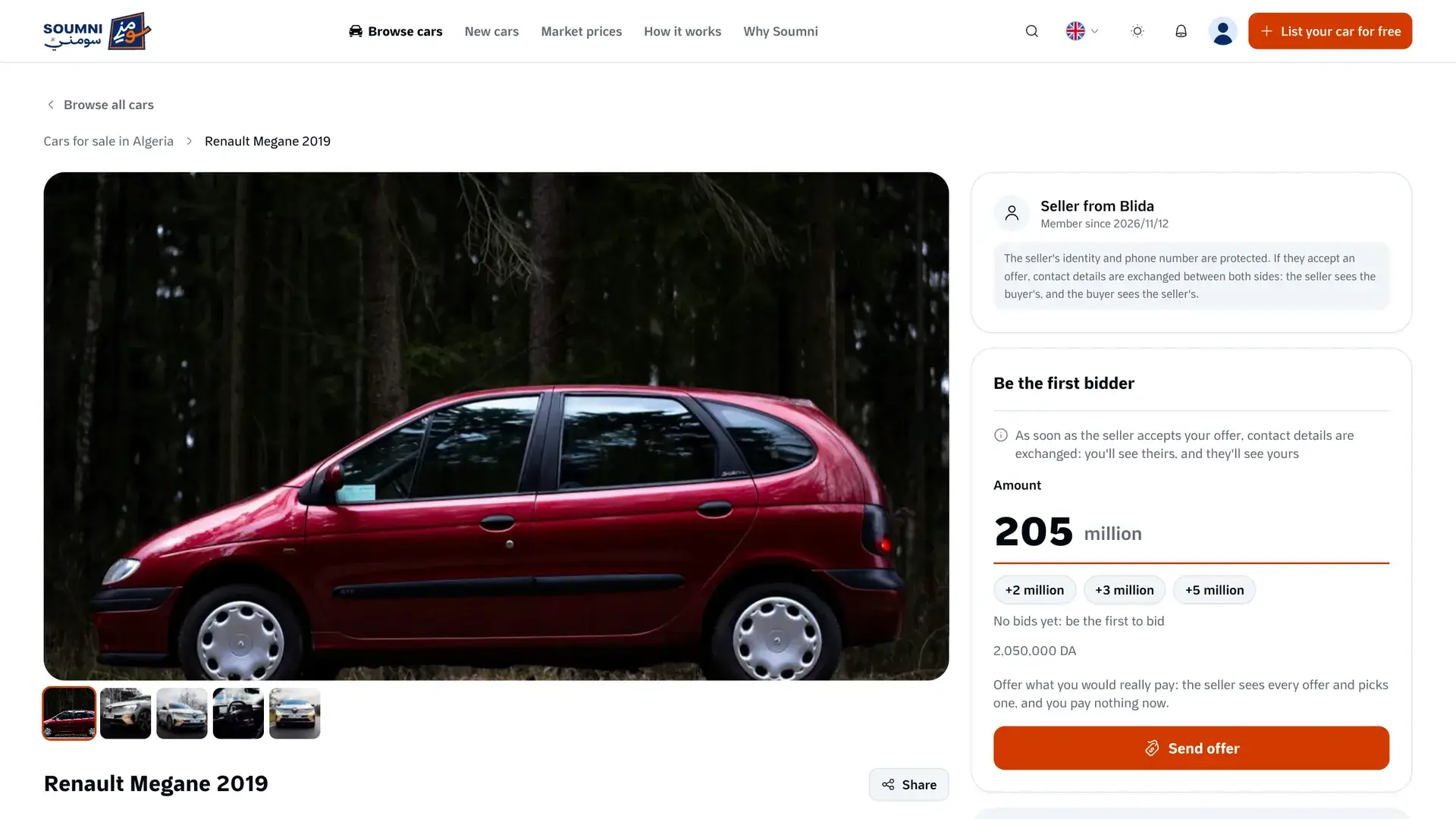
The offer panel counts in millions, with +2, +3 and +5 million steps and the full amount in dinars underneath. 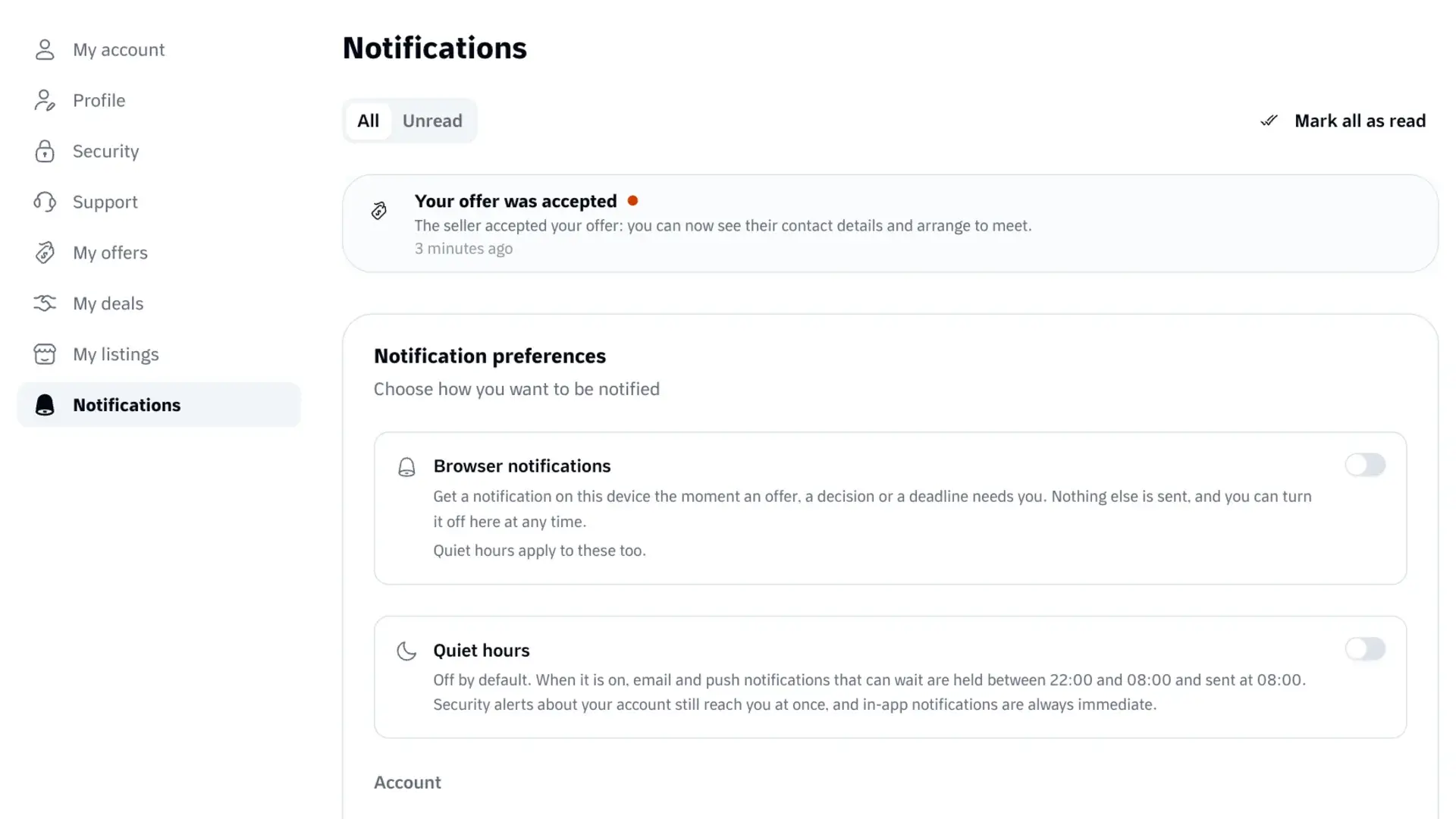
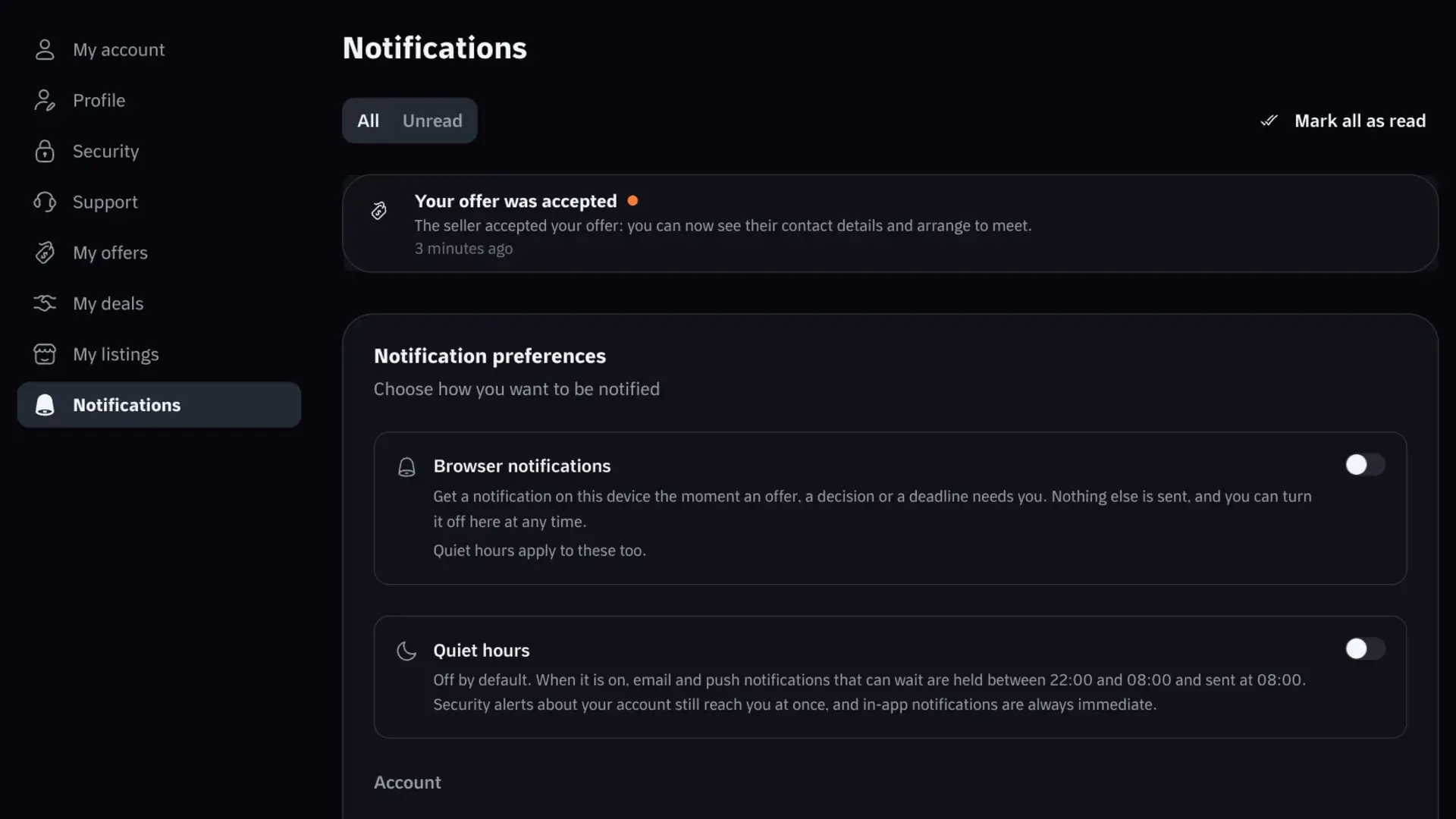
An accepted offer reaches the buyer at once. Each alert can go in the app, by email or as a browser push, and quiet hours hold the others overnight. 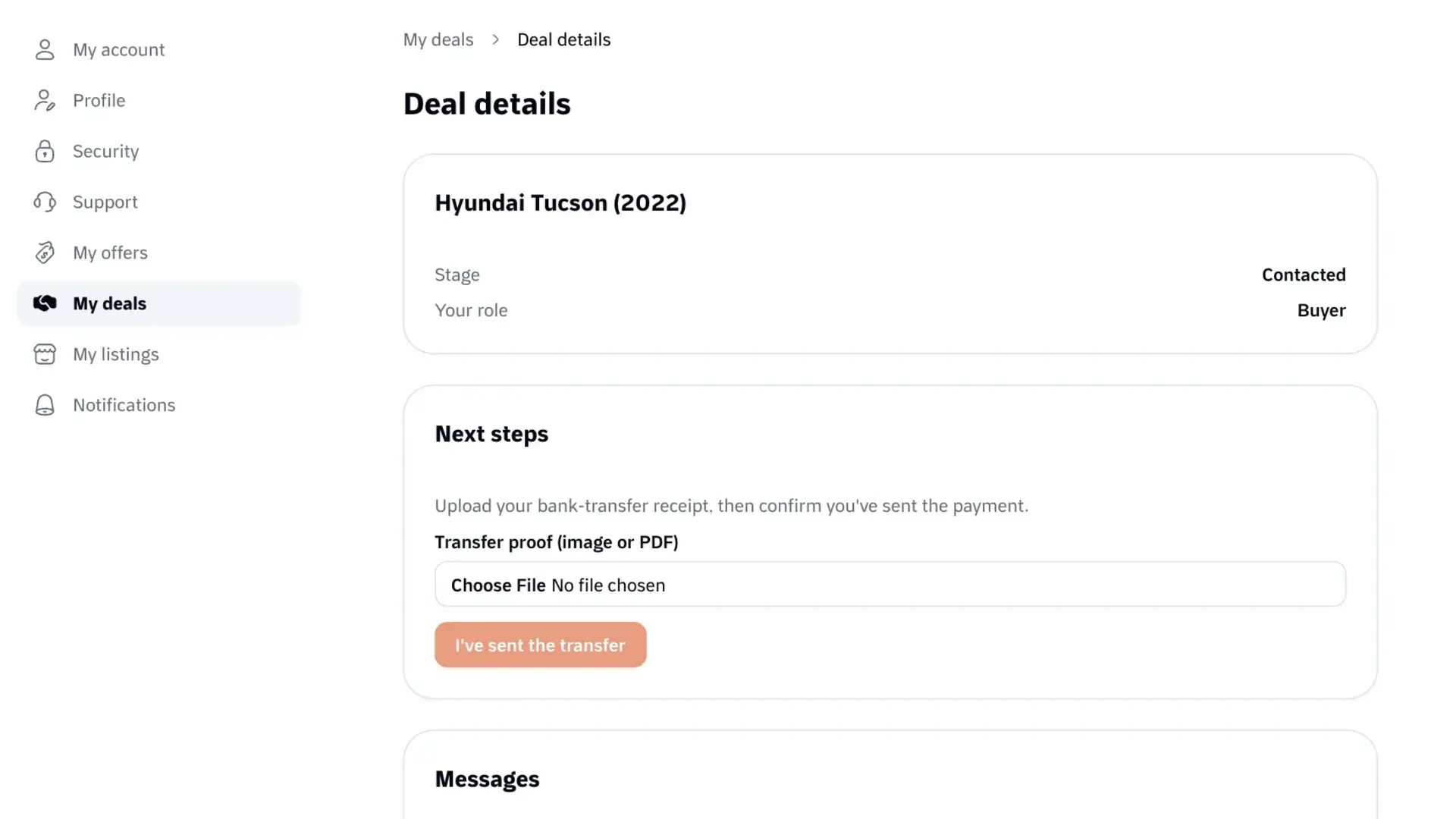
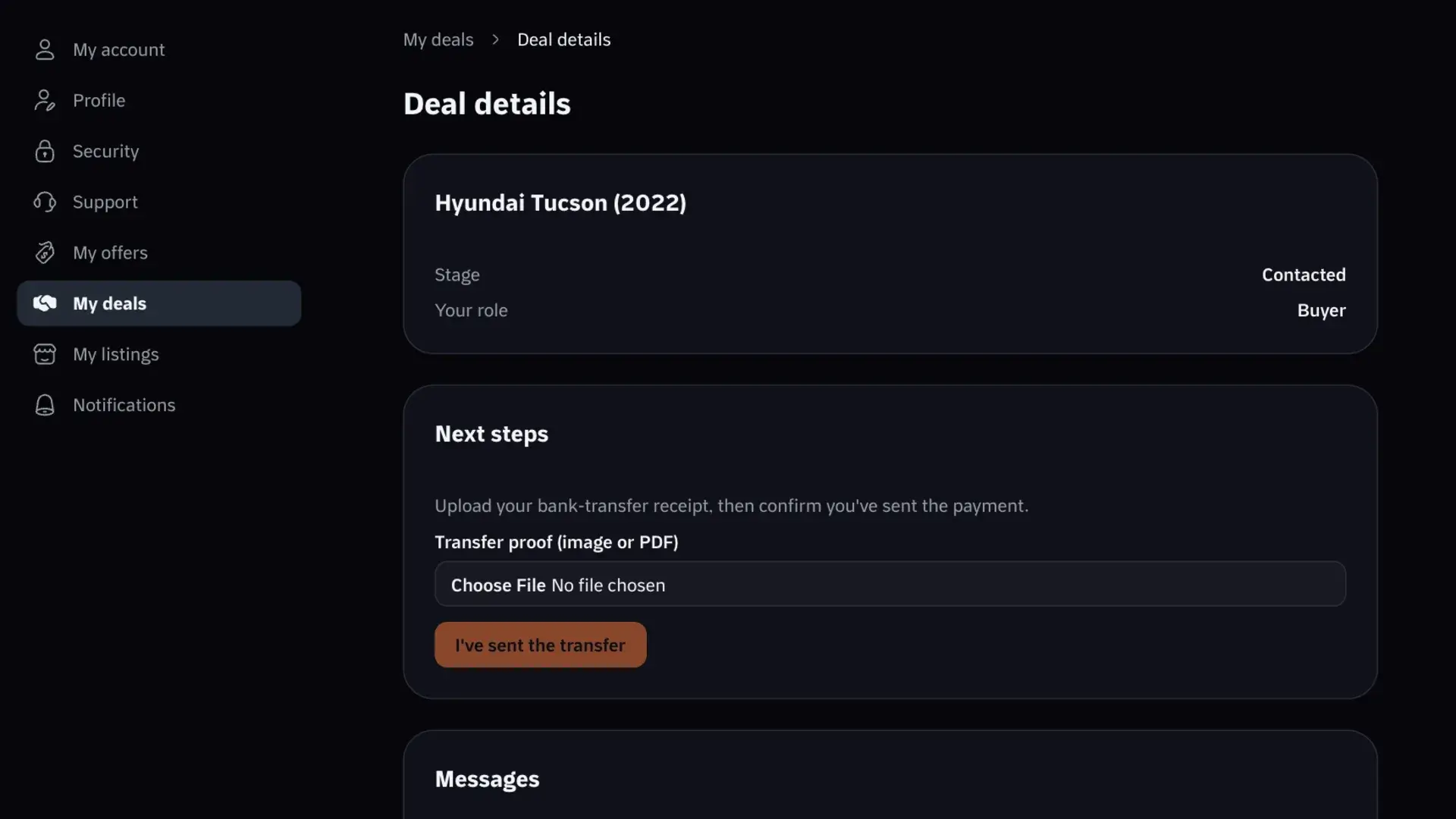
Each deal gets its own page: the stage it has reached, the next step, an upload for the transfer receipt and a message thread.
For sellers
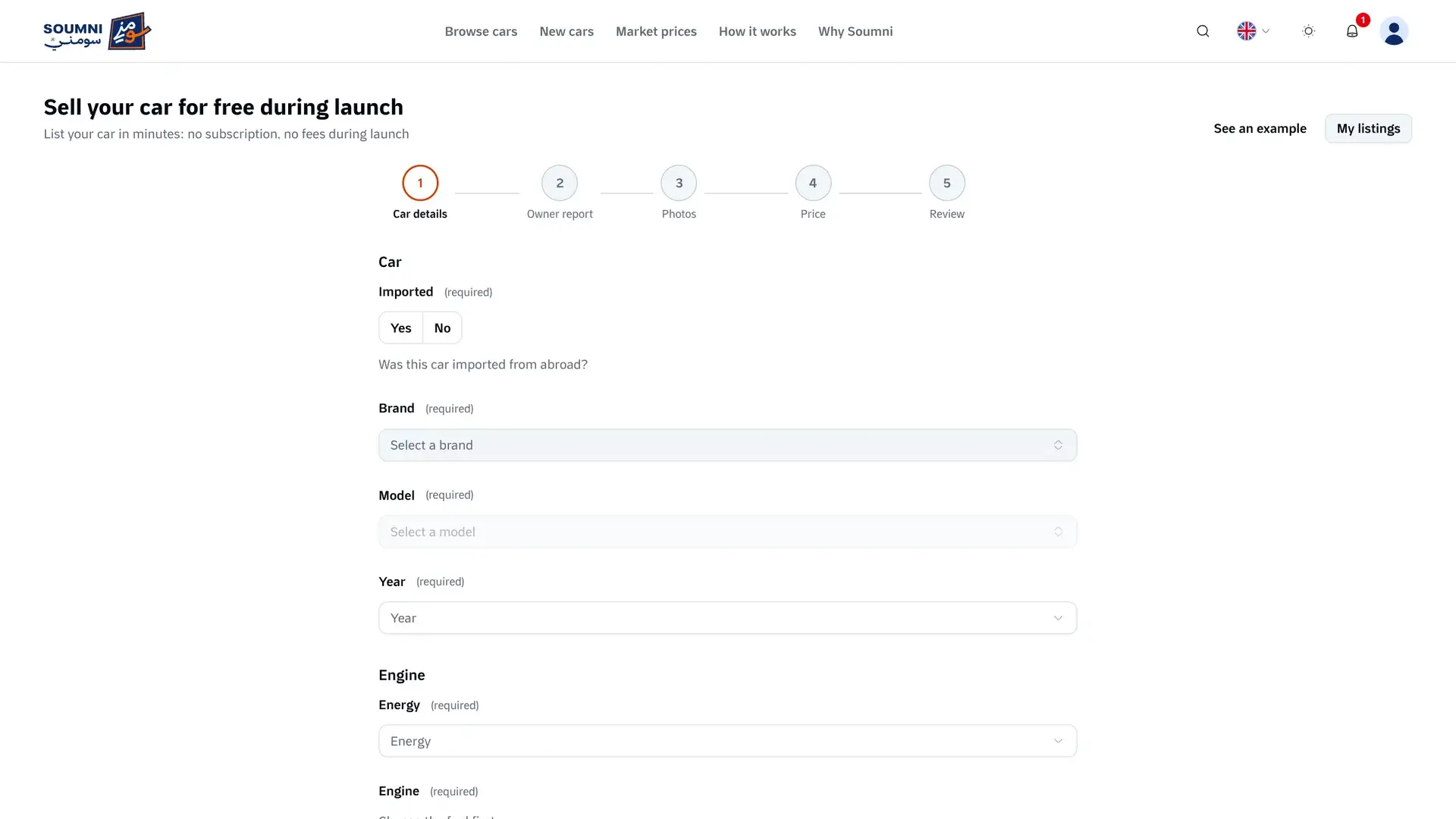
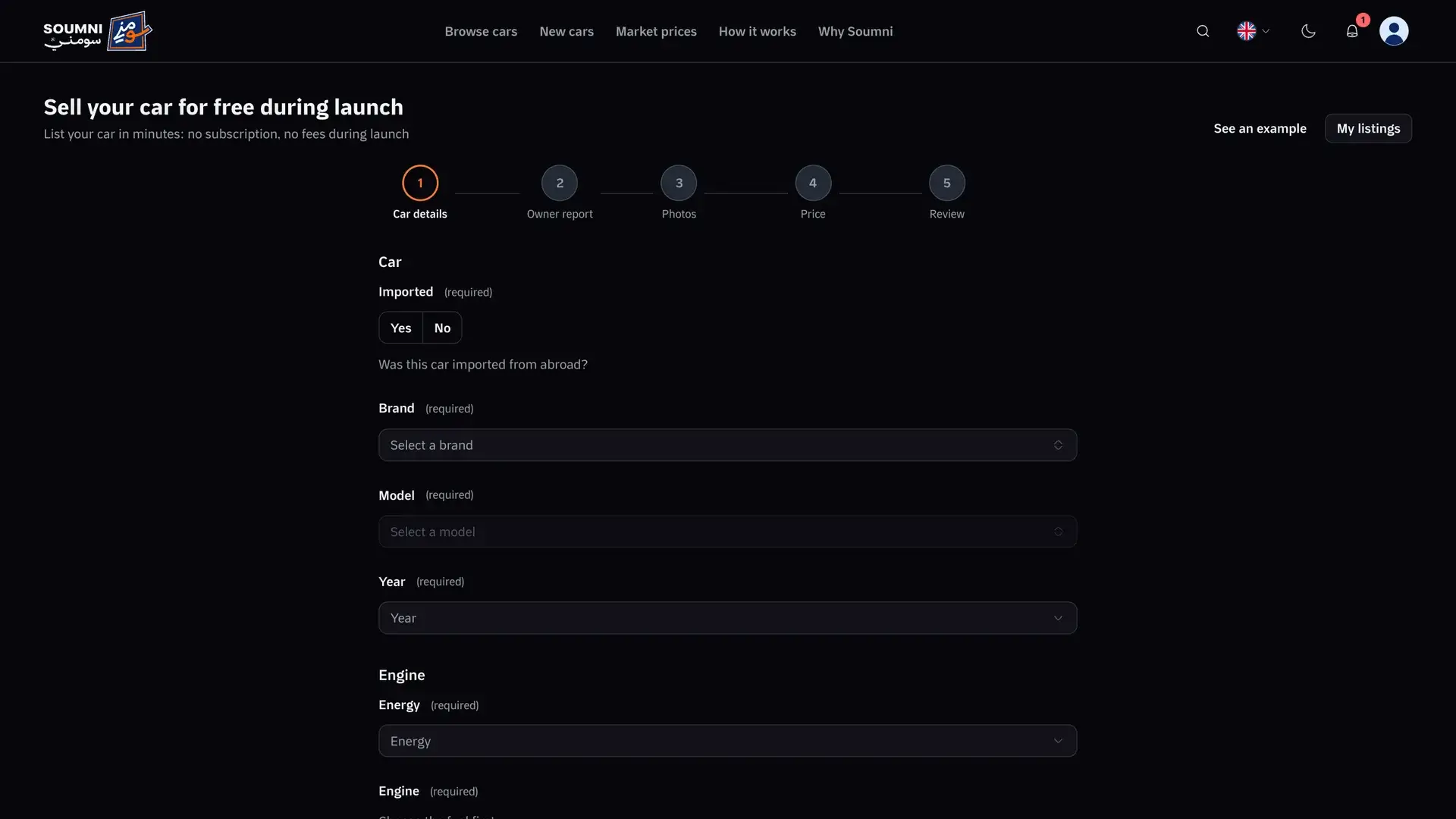
A listing takes five steps: car details, the owner's report, photos, price and a review. Listing is free during launch. 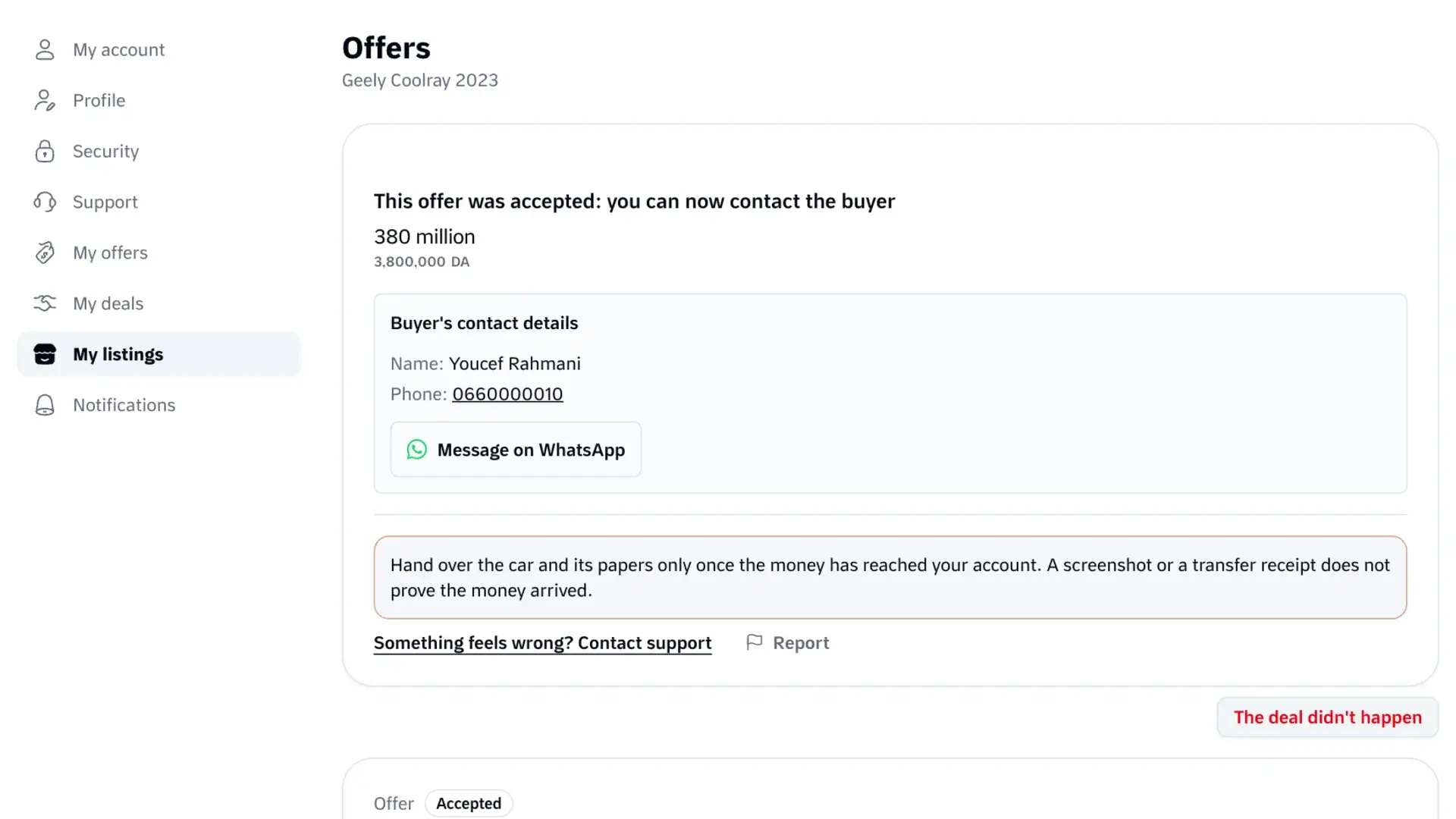
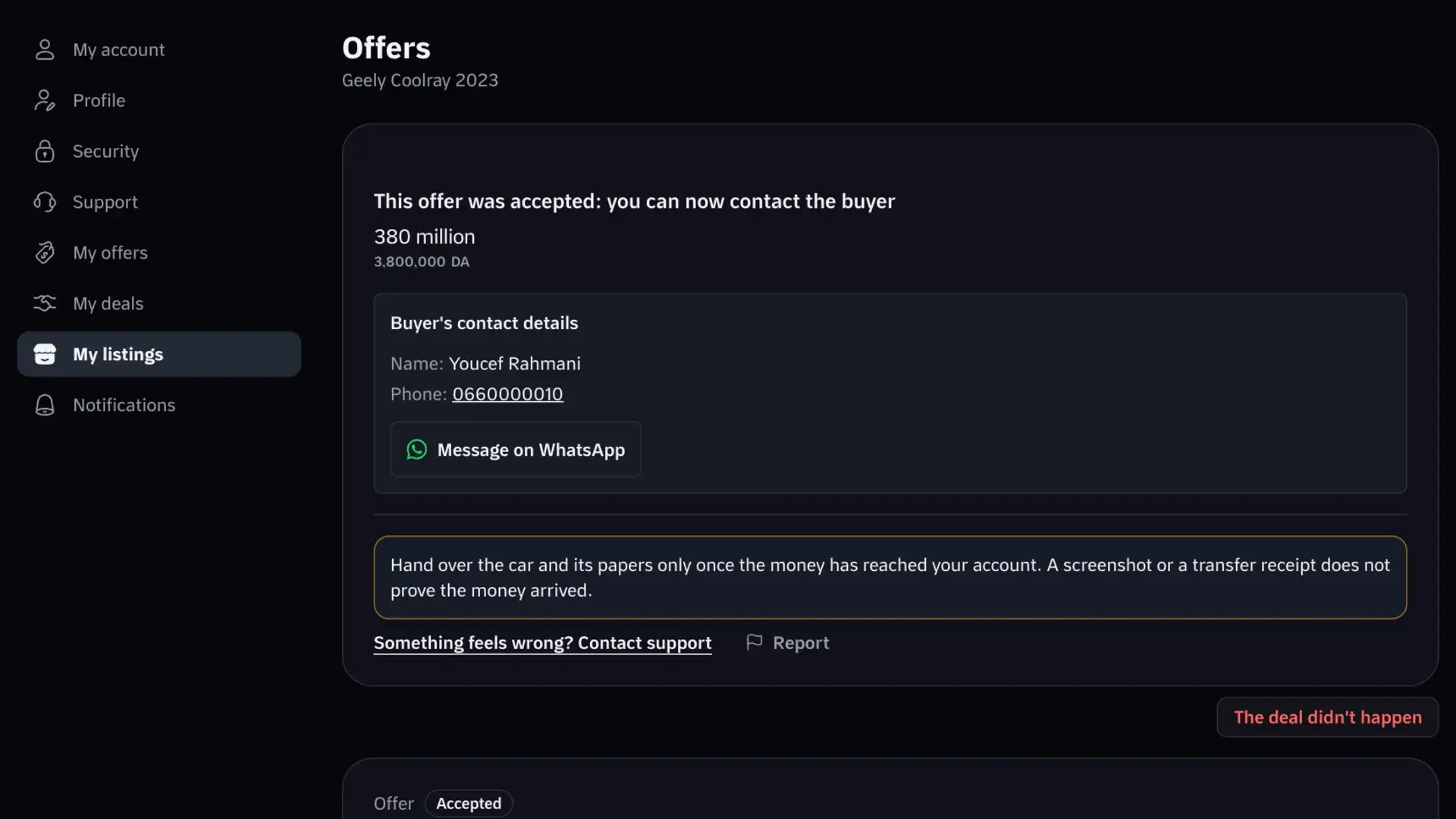
Once the seller accepts, the buyer's name and phone appear, with a WhatsApp button and a reminder to hand over the car only after the money arrives. 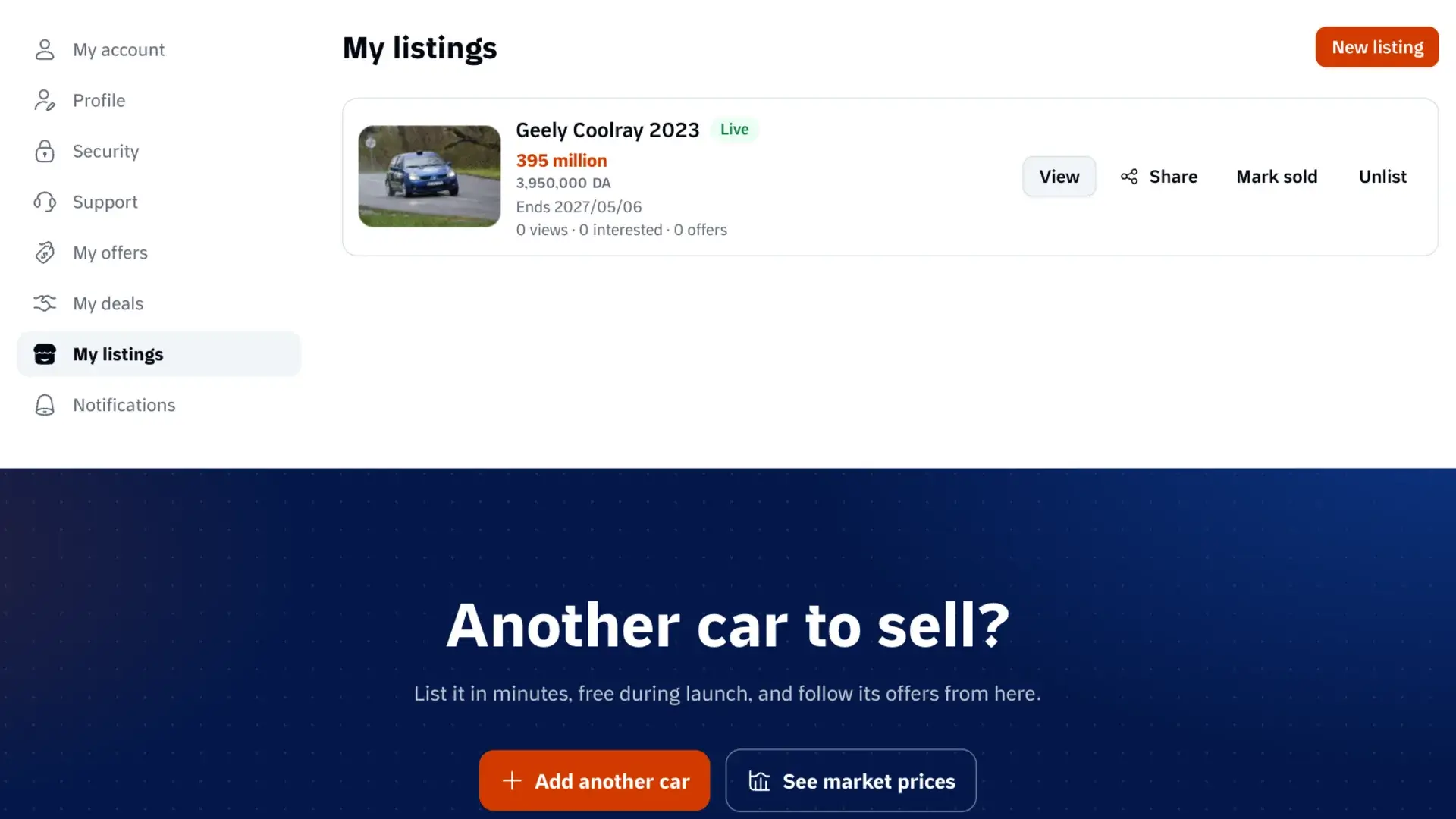
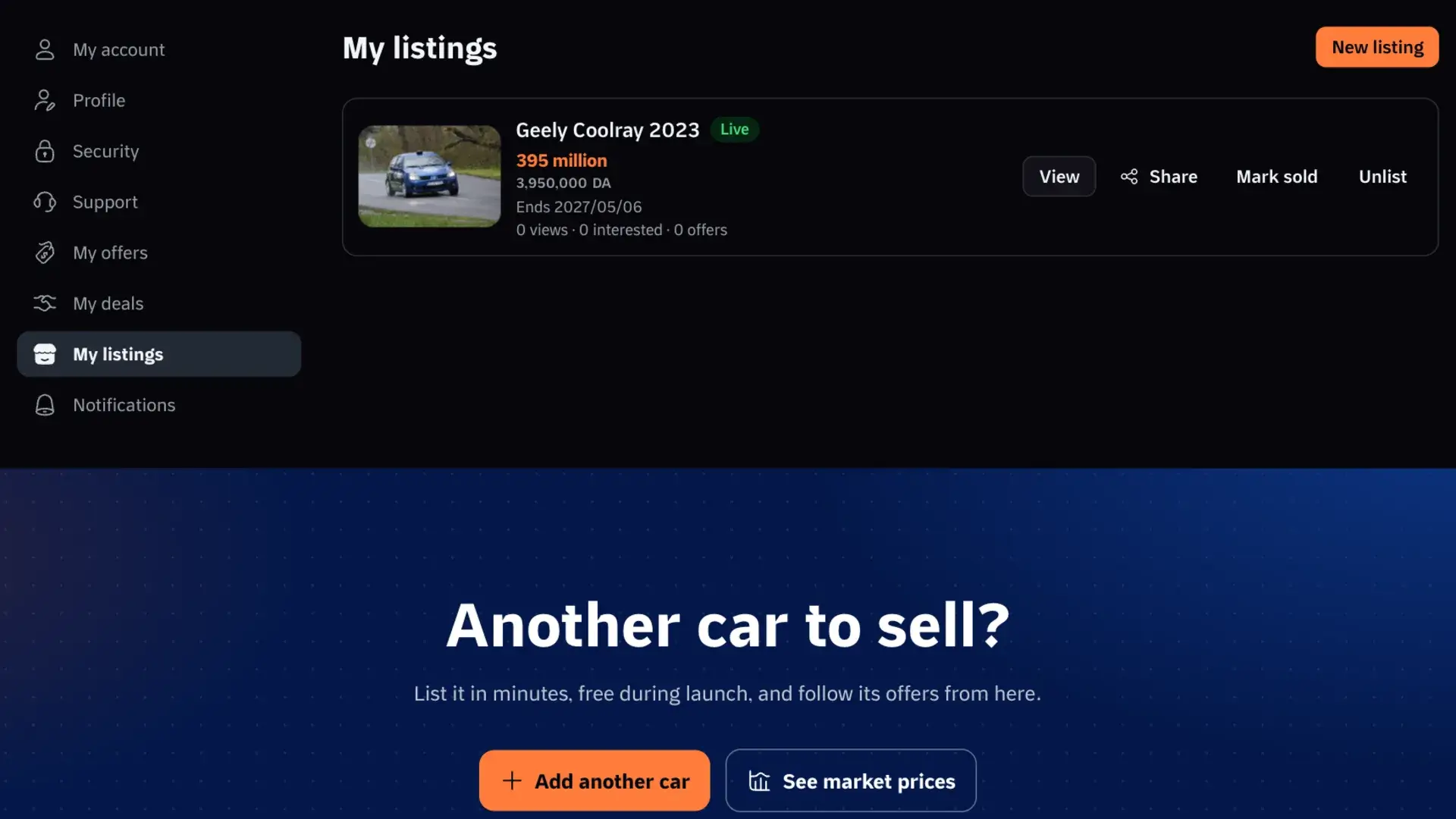
My listings shows each car's status, price, views and offers, with share, mark sold and unlist beside it.
For staff
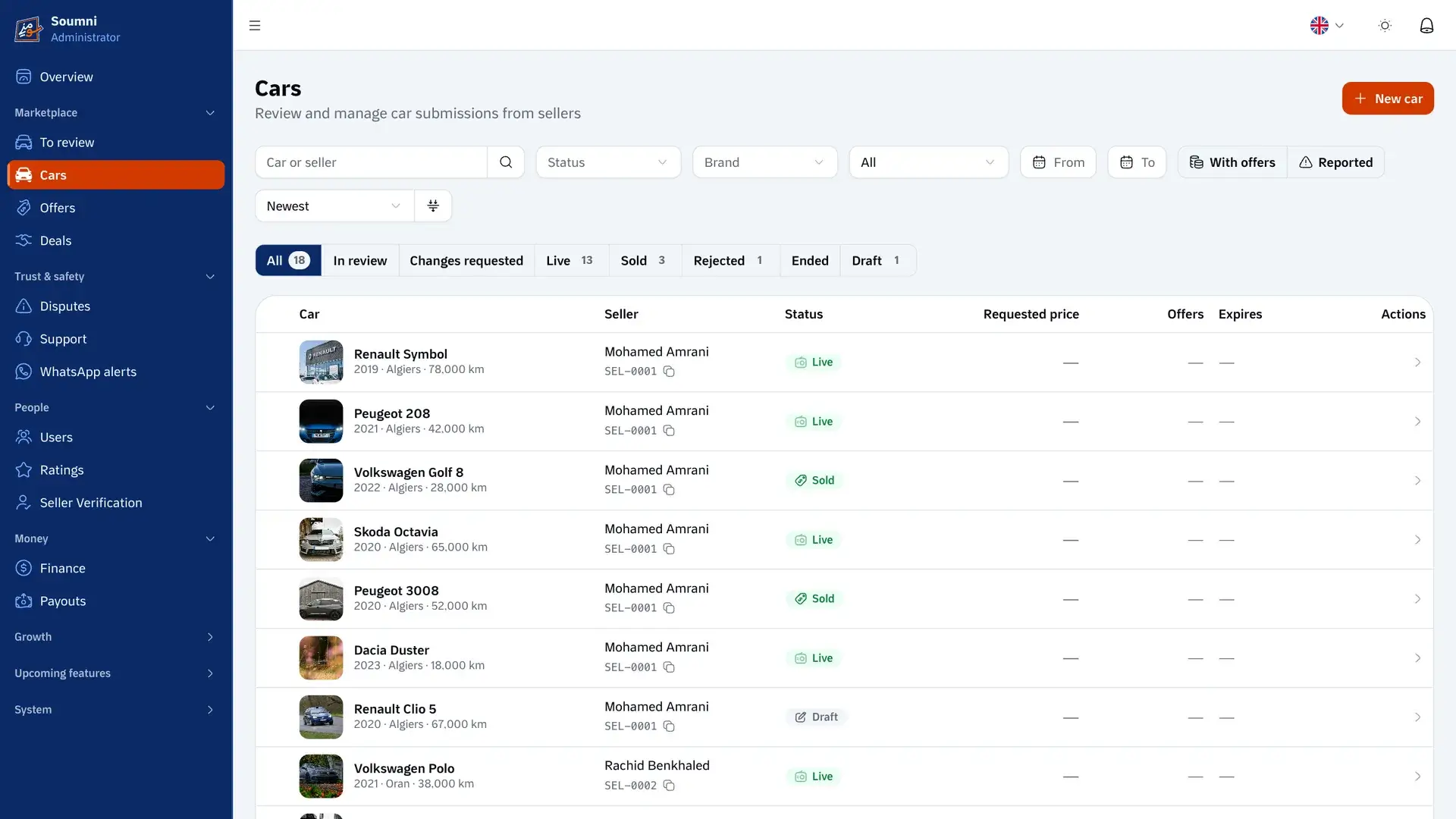
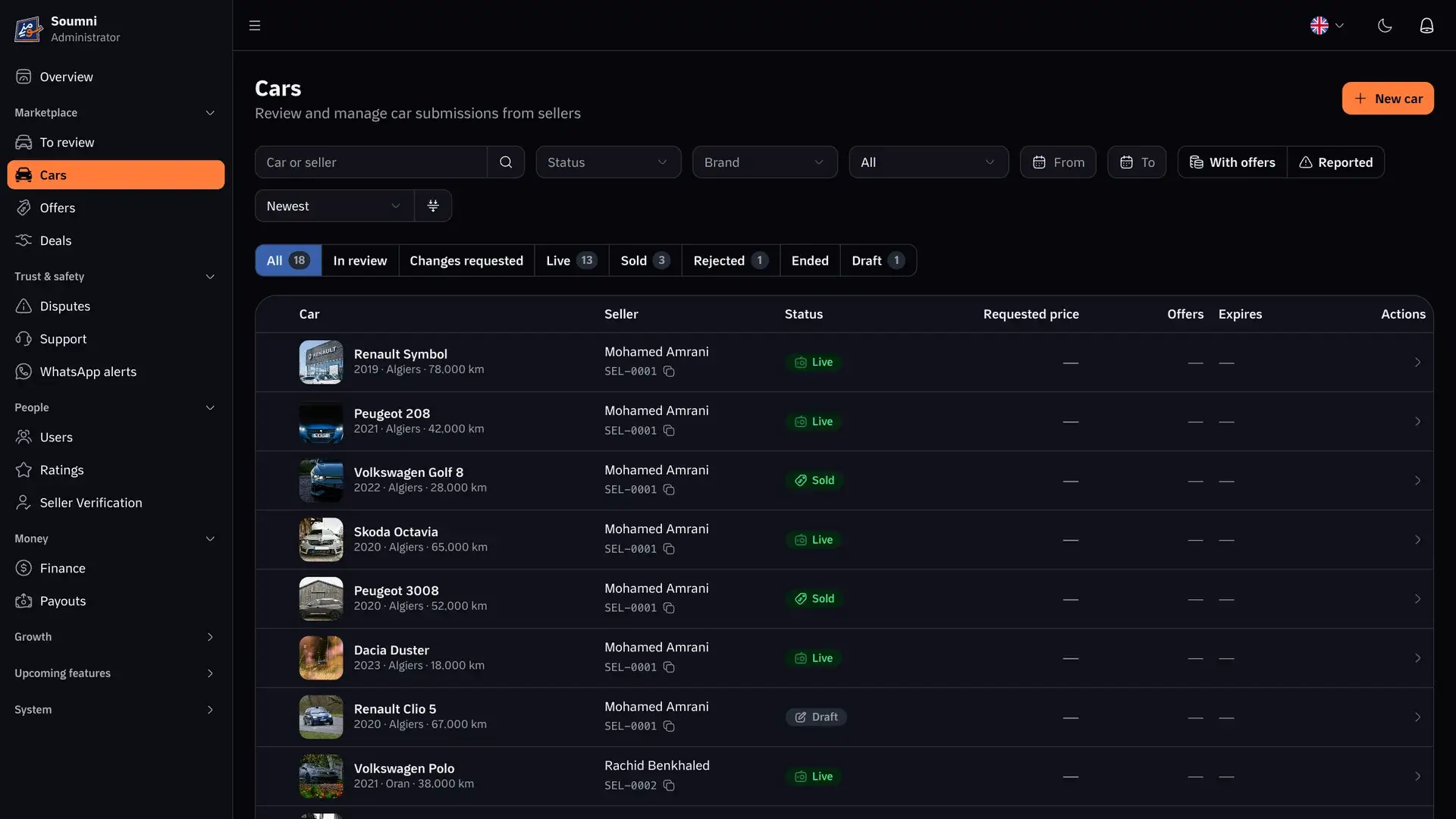
Staff moderate every car submitted, with a tab for each status and filters for brand, dates, offers and reports. 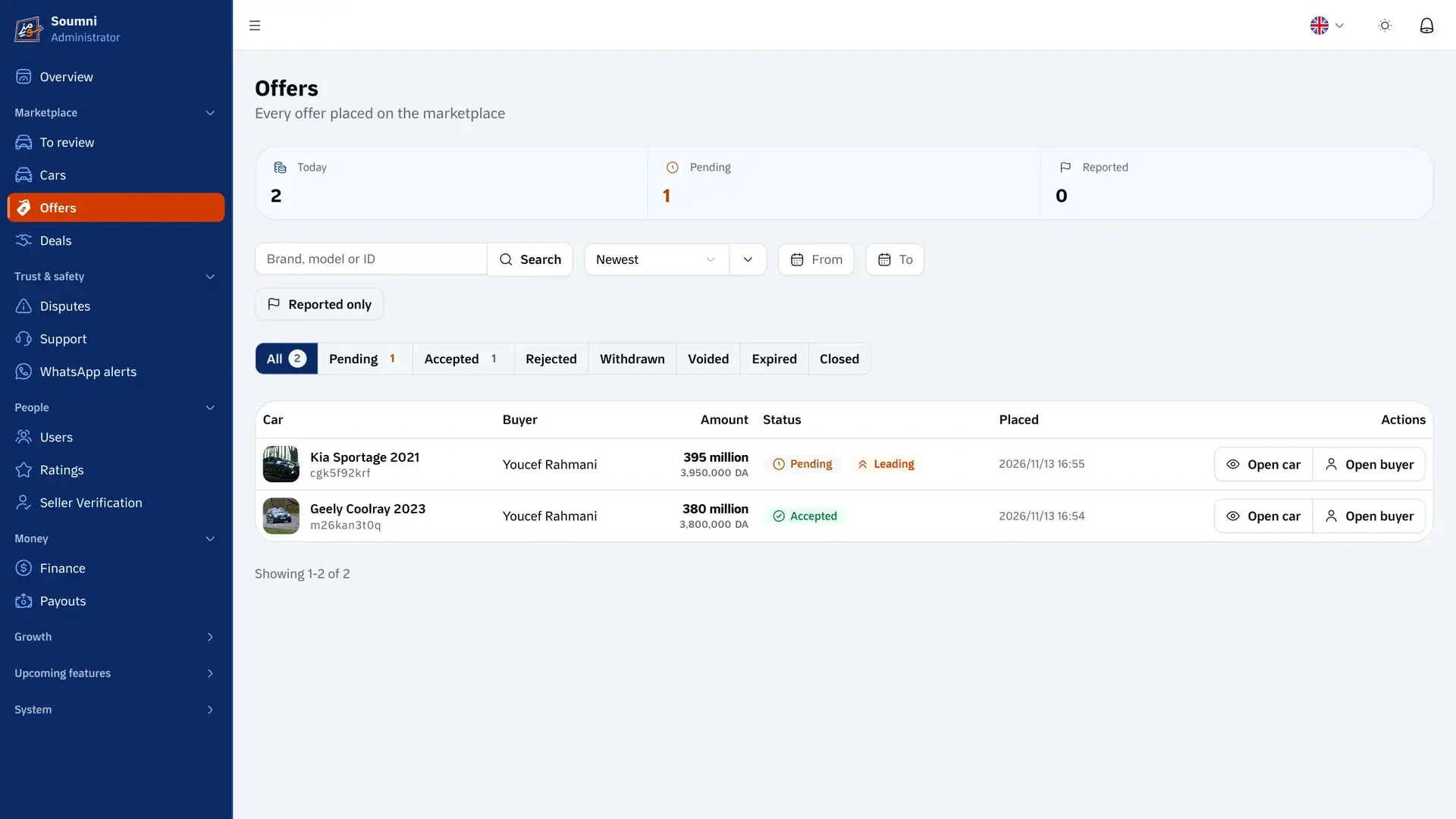
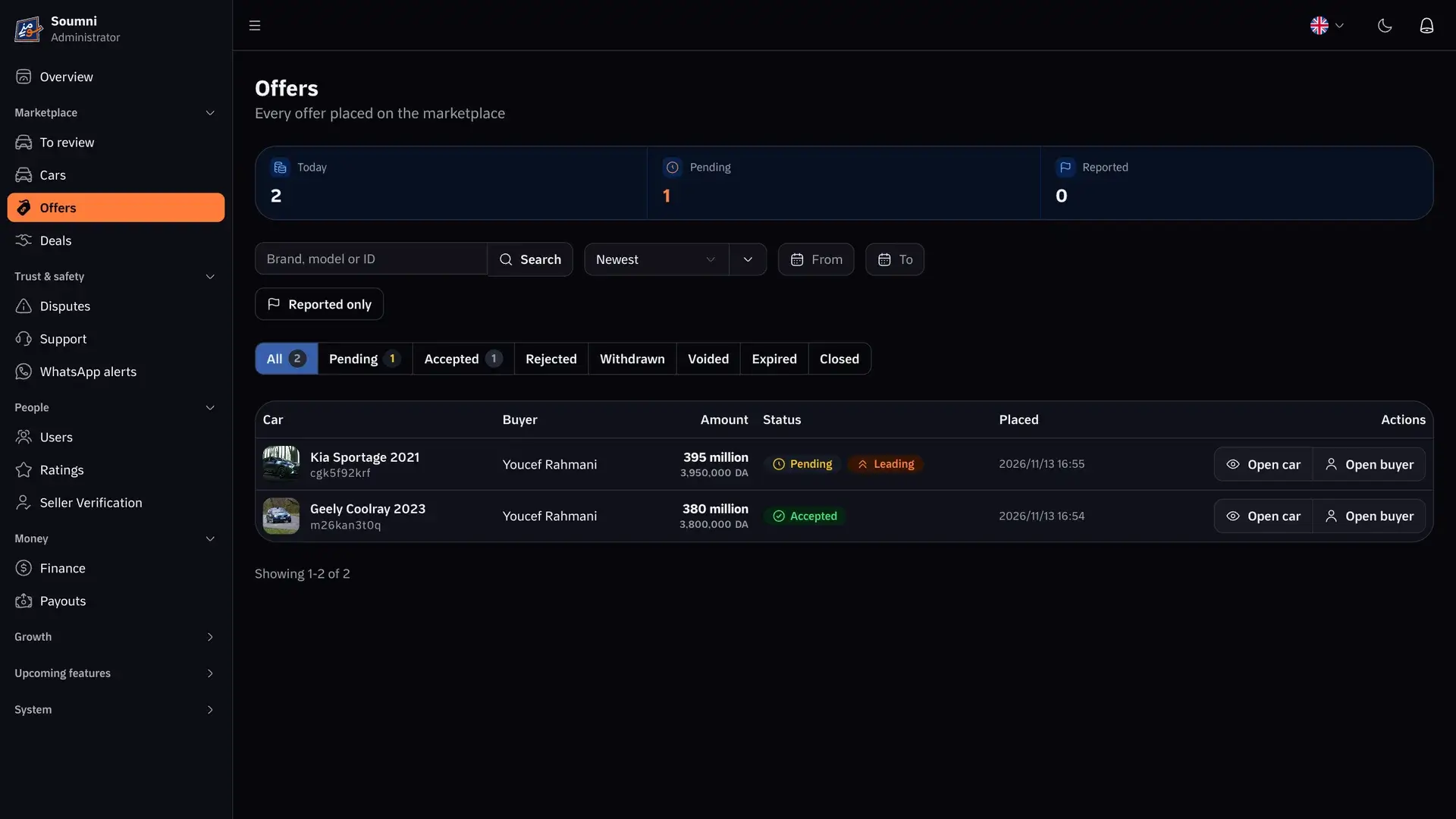
Every offer on the marketplace in one table, the leading one flagged, with a filter for reported offers. 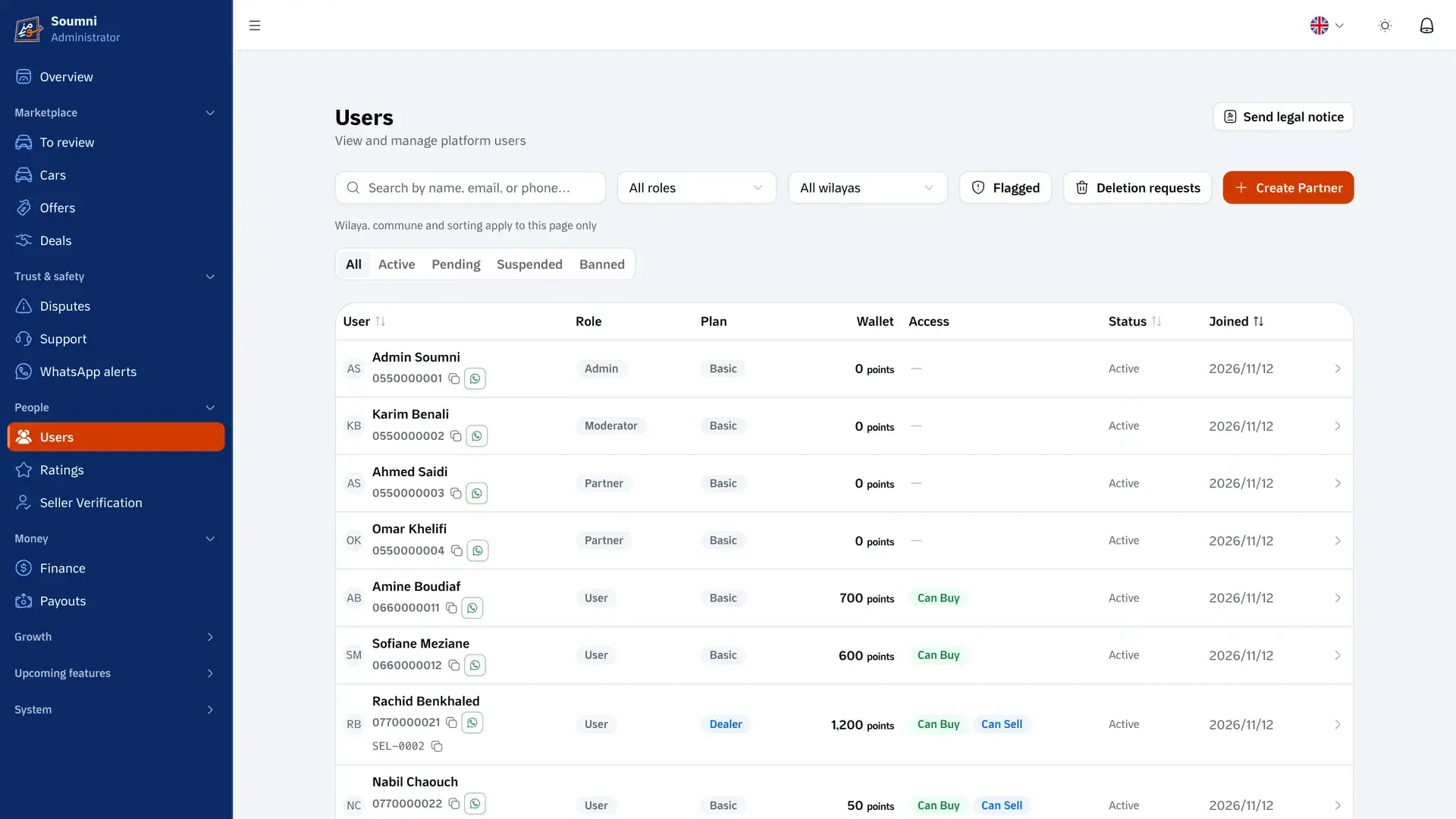
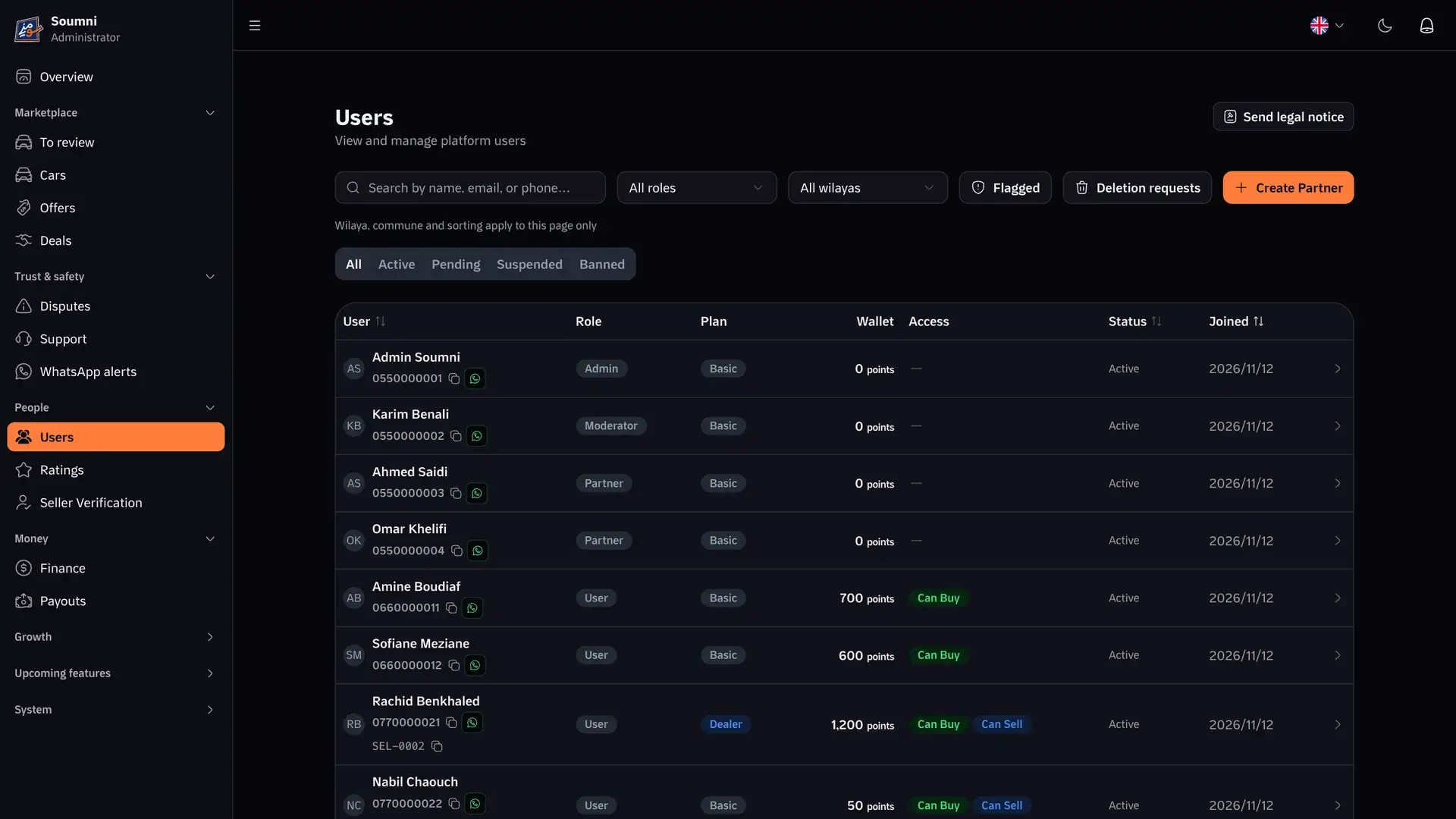
Each user has a role, a plan, a wallet balance and separate rights to buy and to sell.
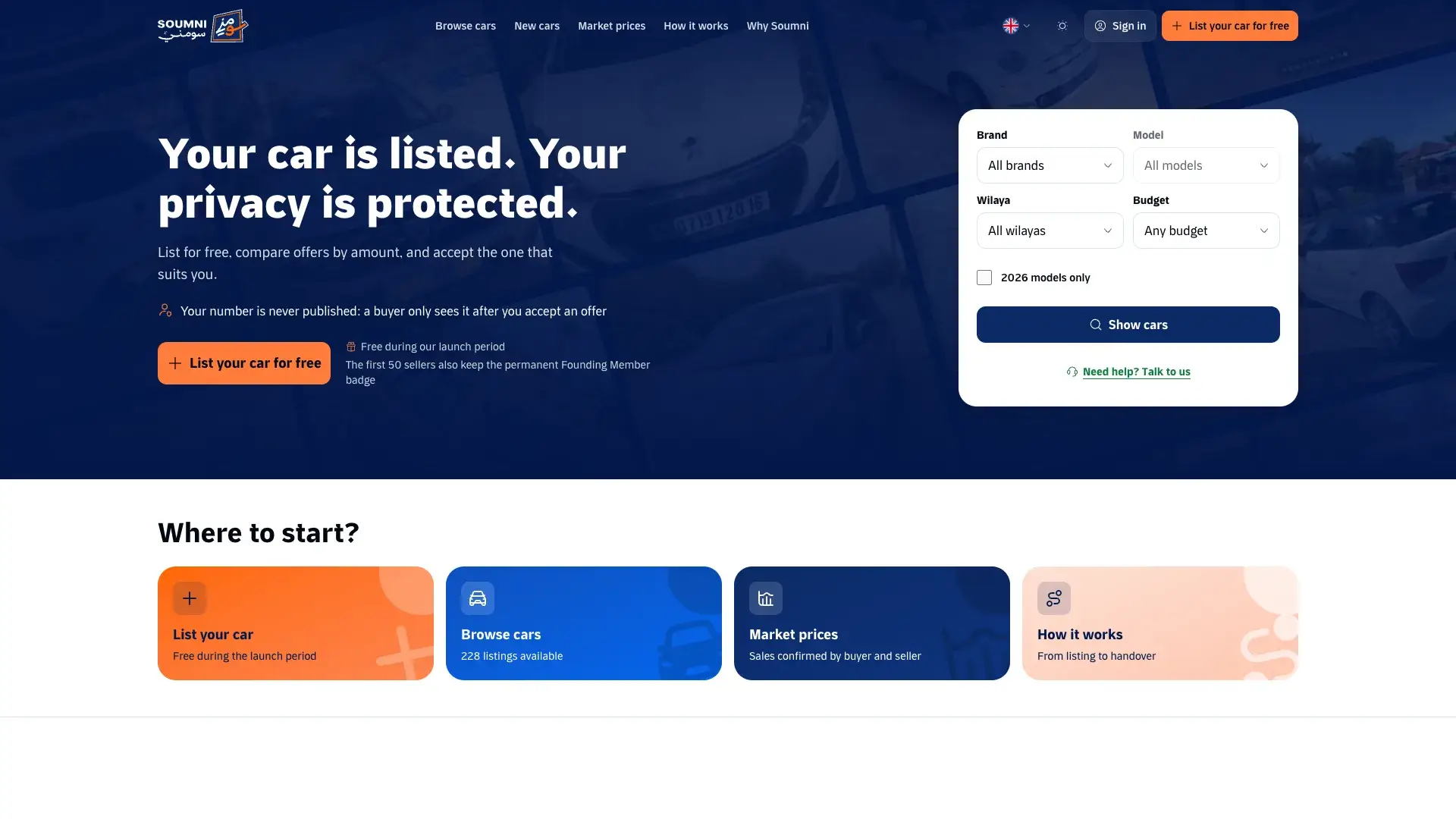
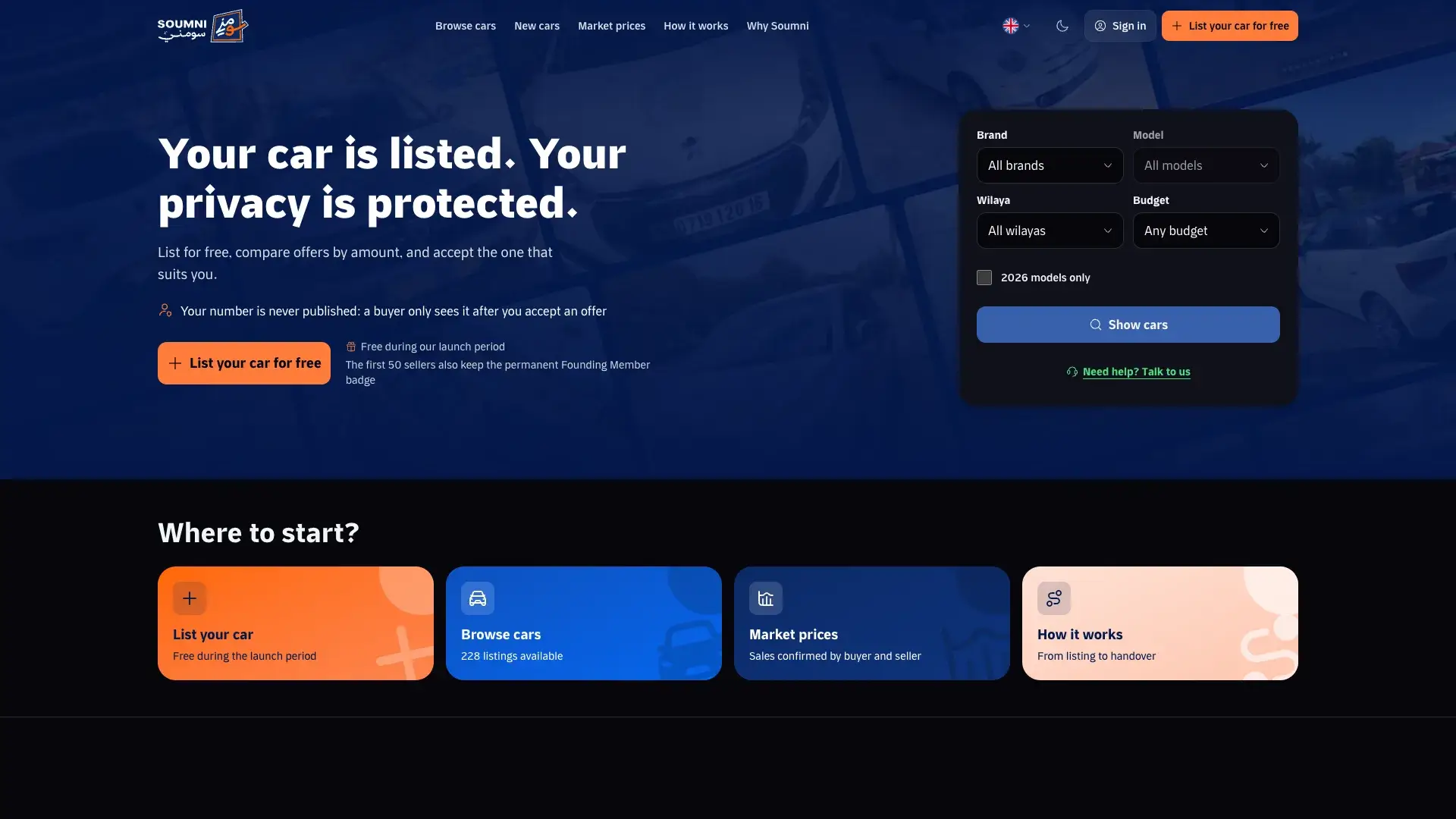
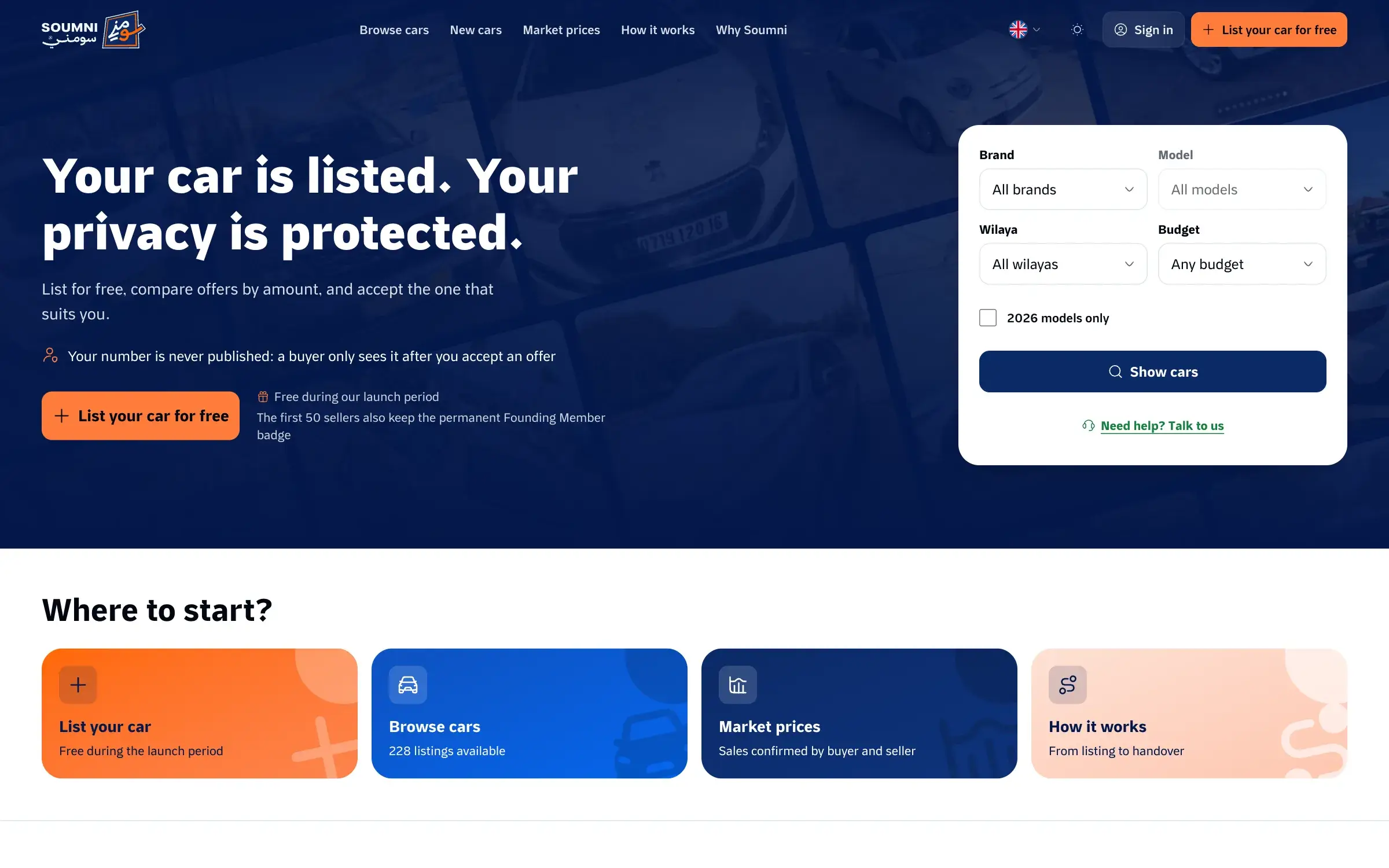
The home page puts search first: brand, wilaya and budget, with the promise that a seller's number stays private. 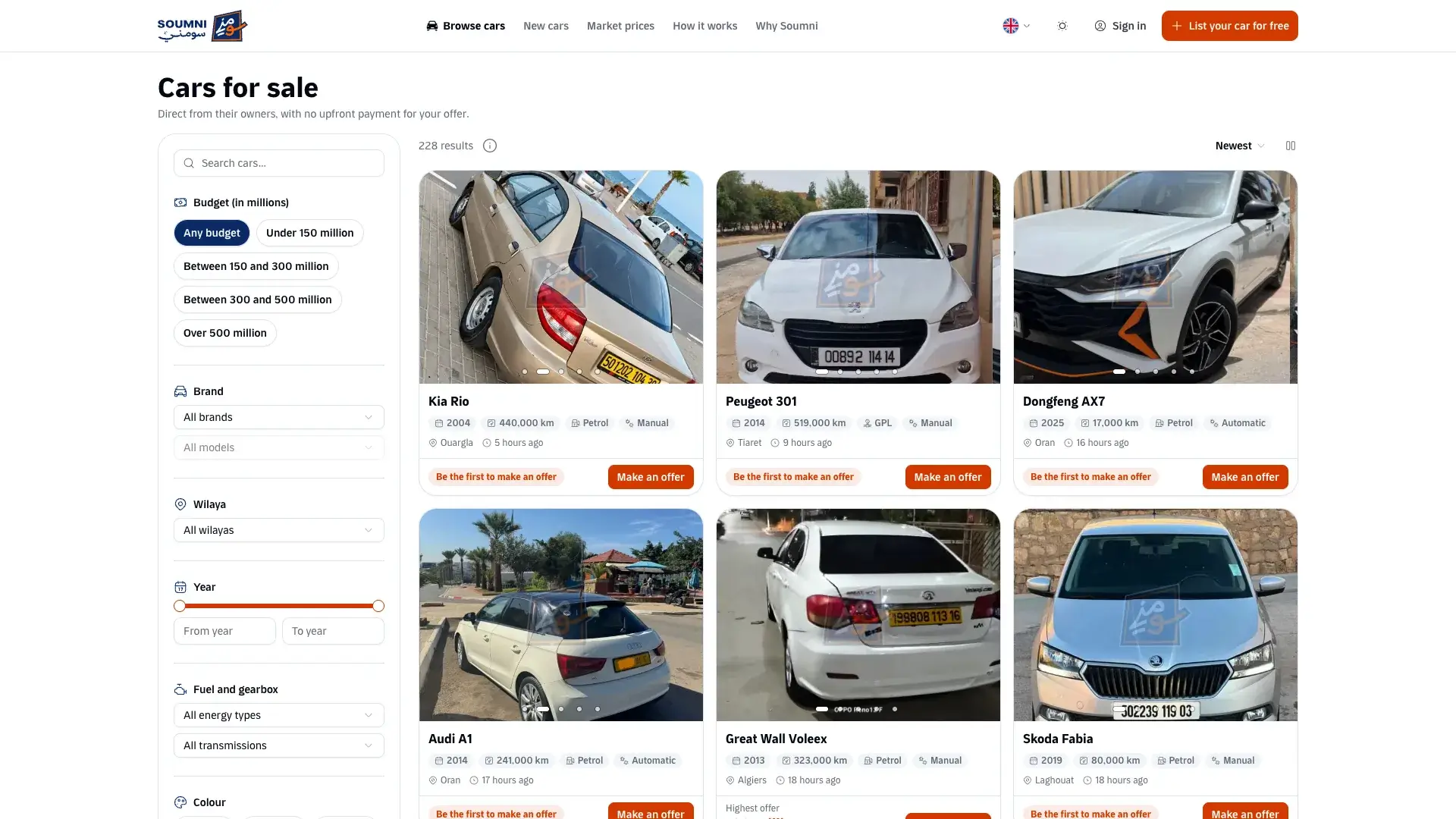
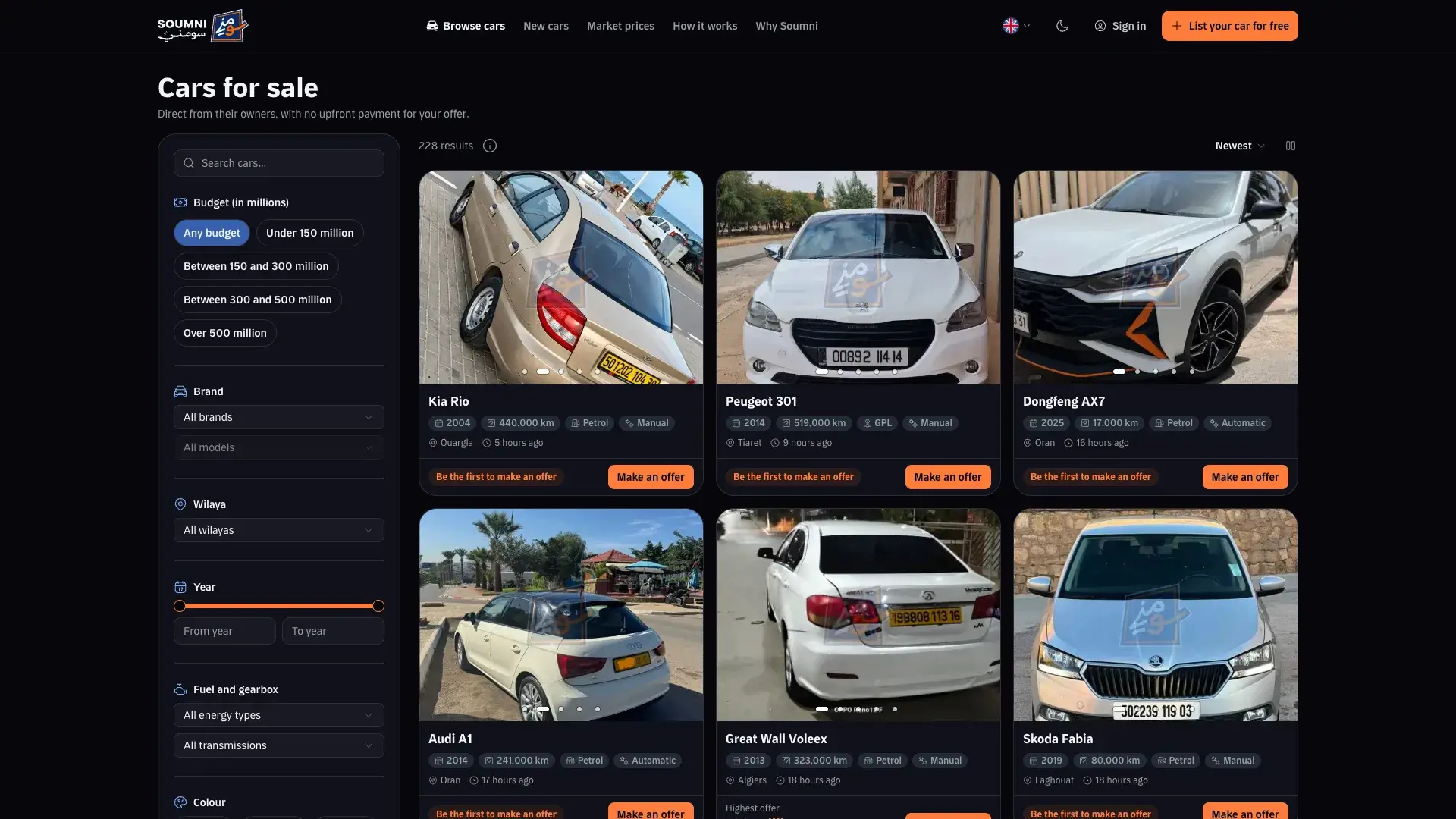
Browsing needs no account. Filter by budget, brand and wilaya, and every card carries the year, the mileage and where the car is. 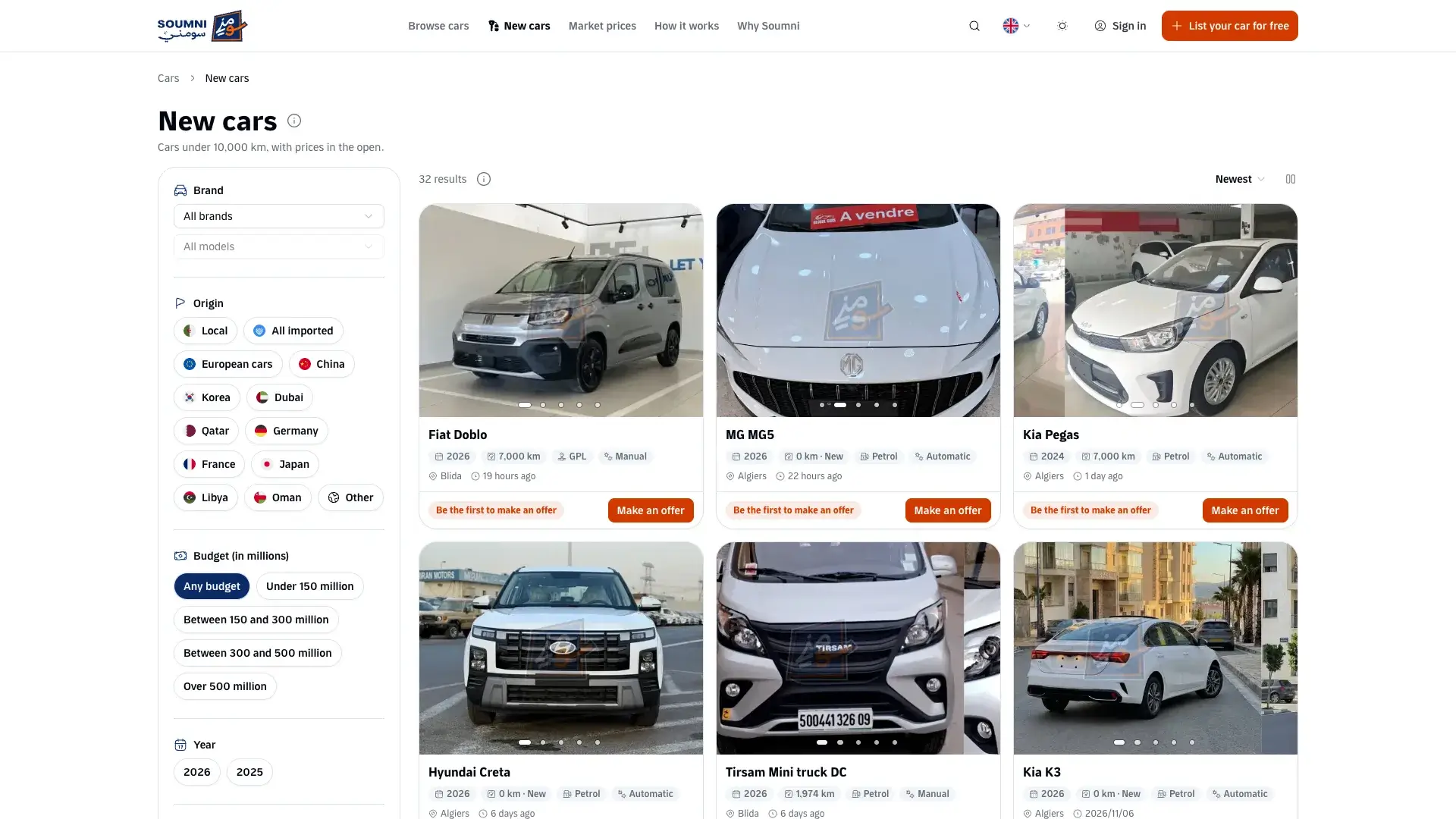
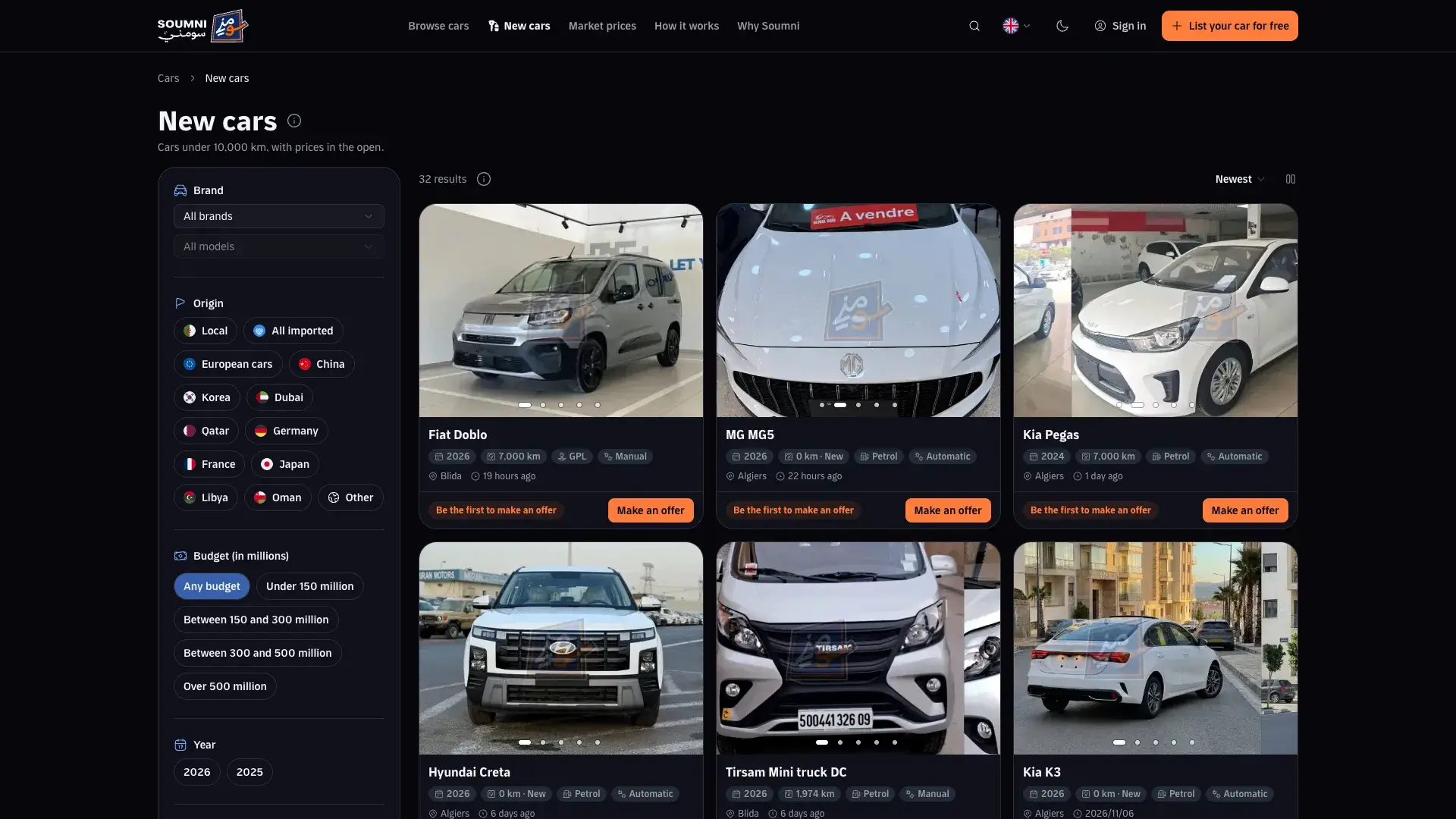
New cars, meaning under 10,000 km, with a filter for origin: assembled locally or imported from Europe, China, Korea or the Gulf. 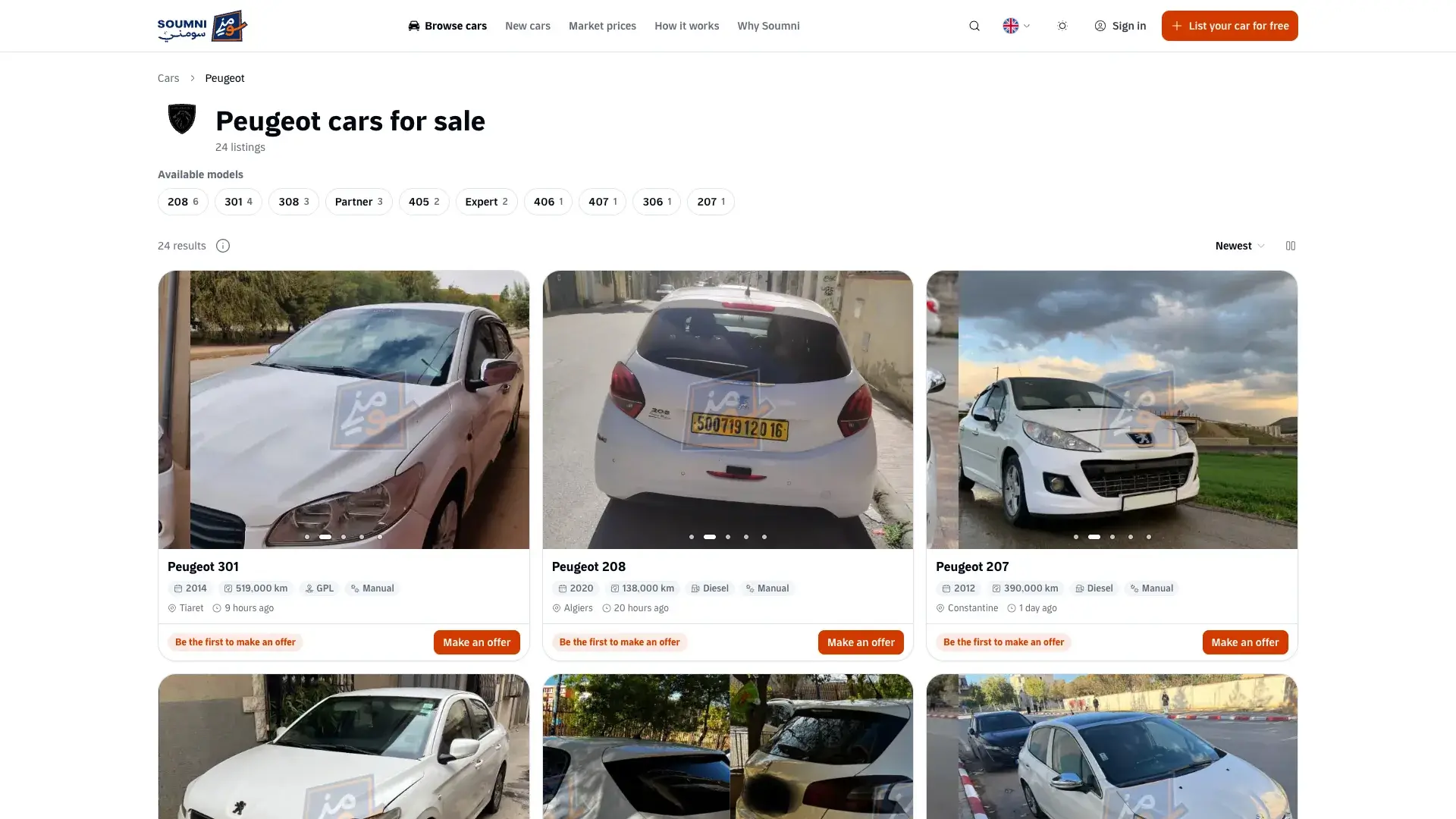
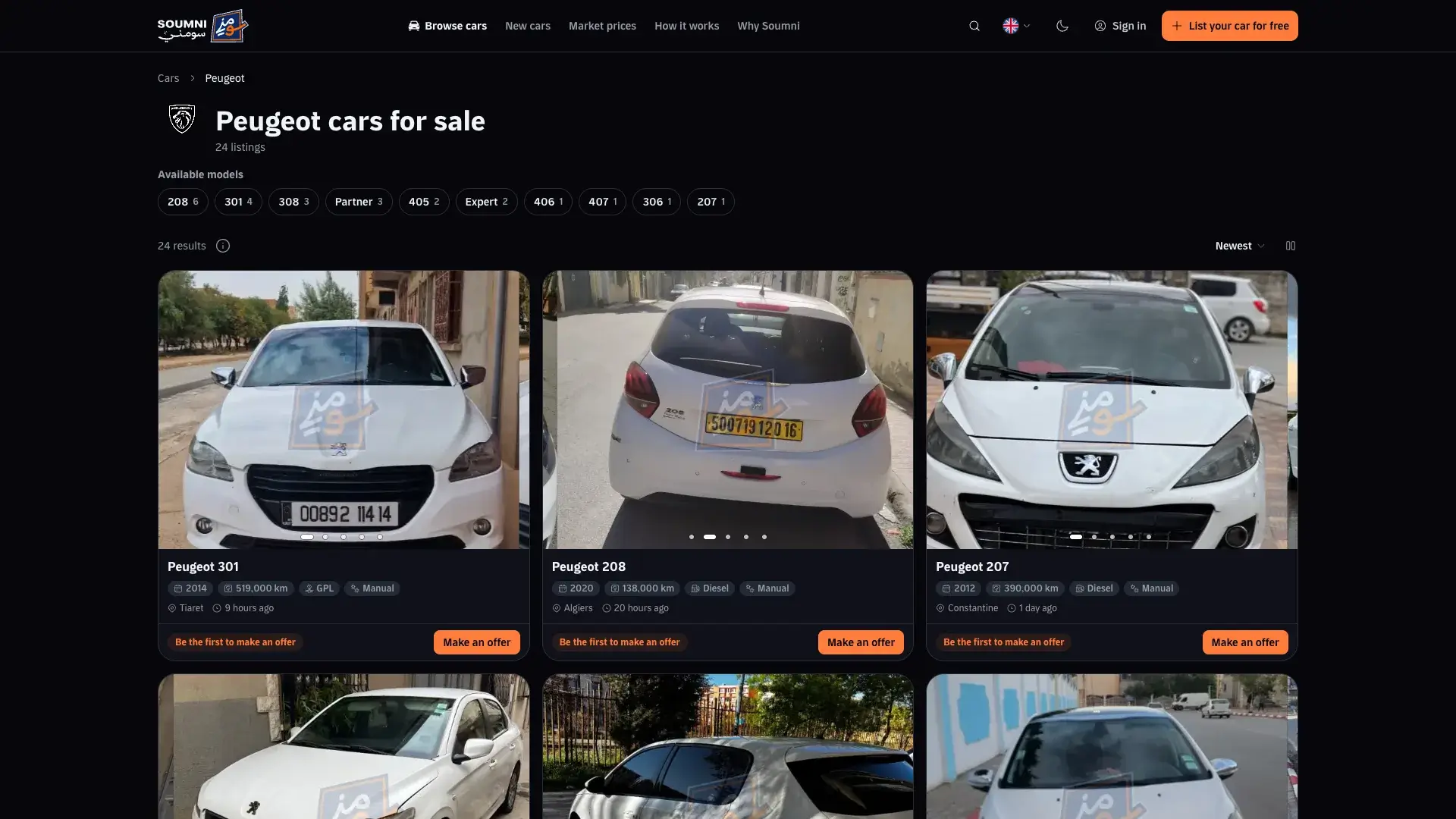
Each brand has its own page, with the models on sale and a count for each, so a search for a Peugeot lands on Peugeots. 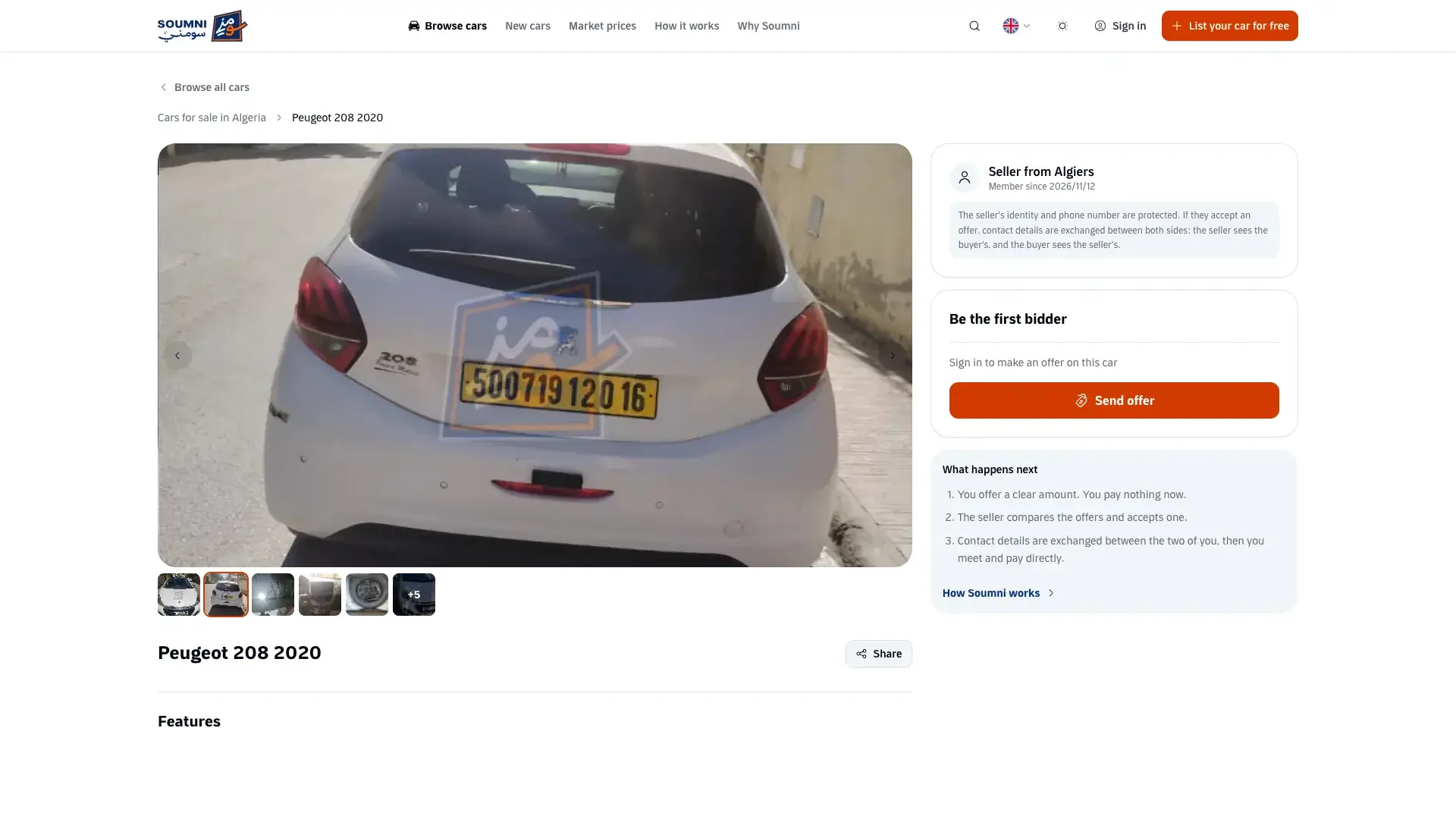
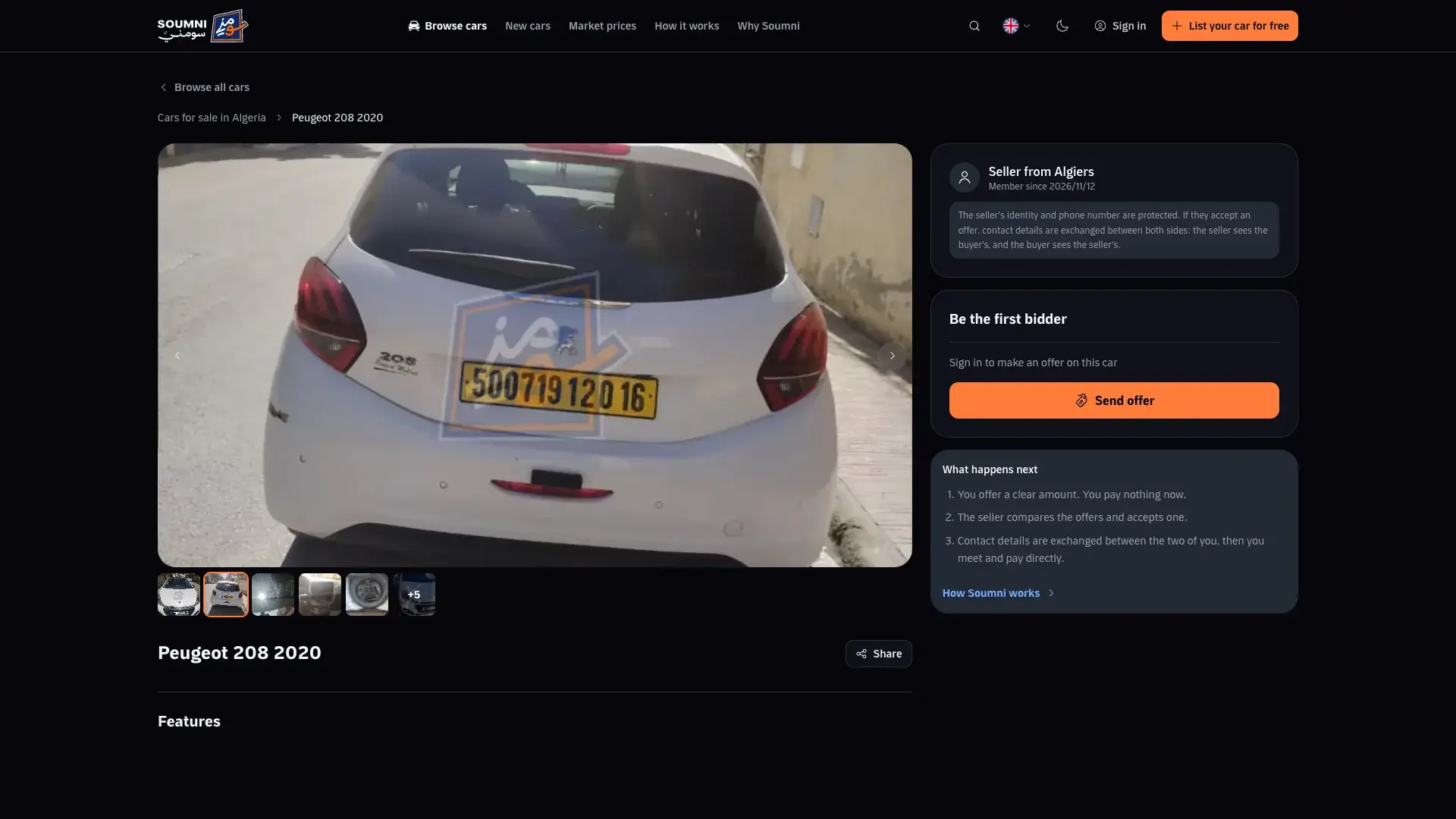
A listing. The seller shows only as a seller from their wilaya, and phone numbers are exchanged once they accept an offer. 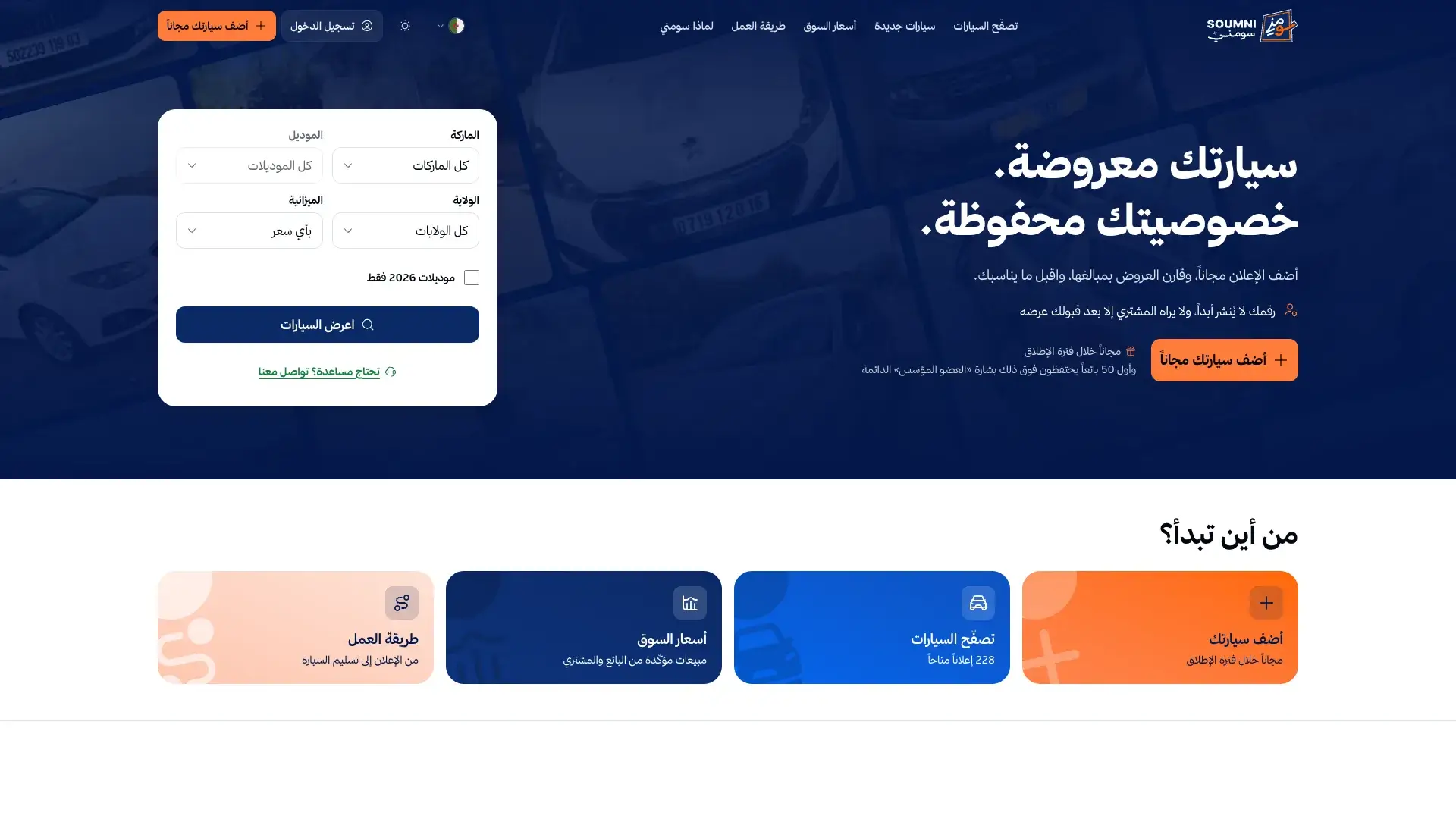
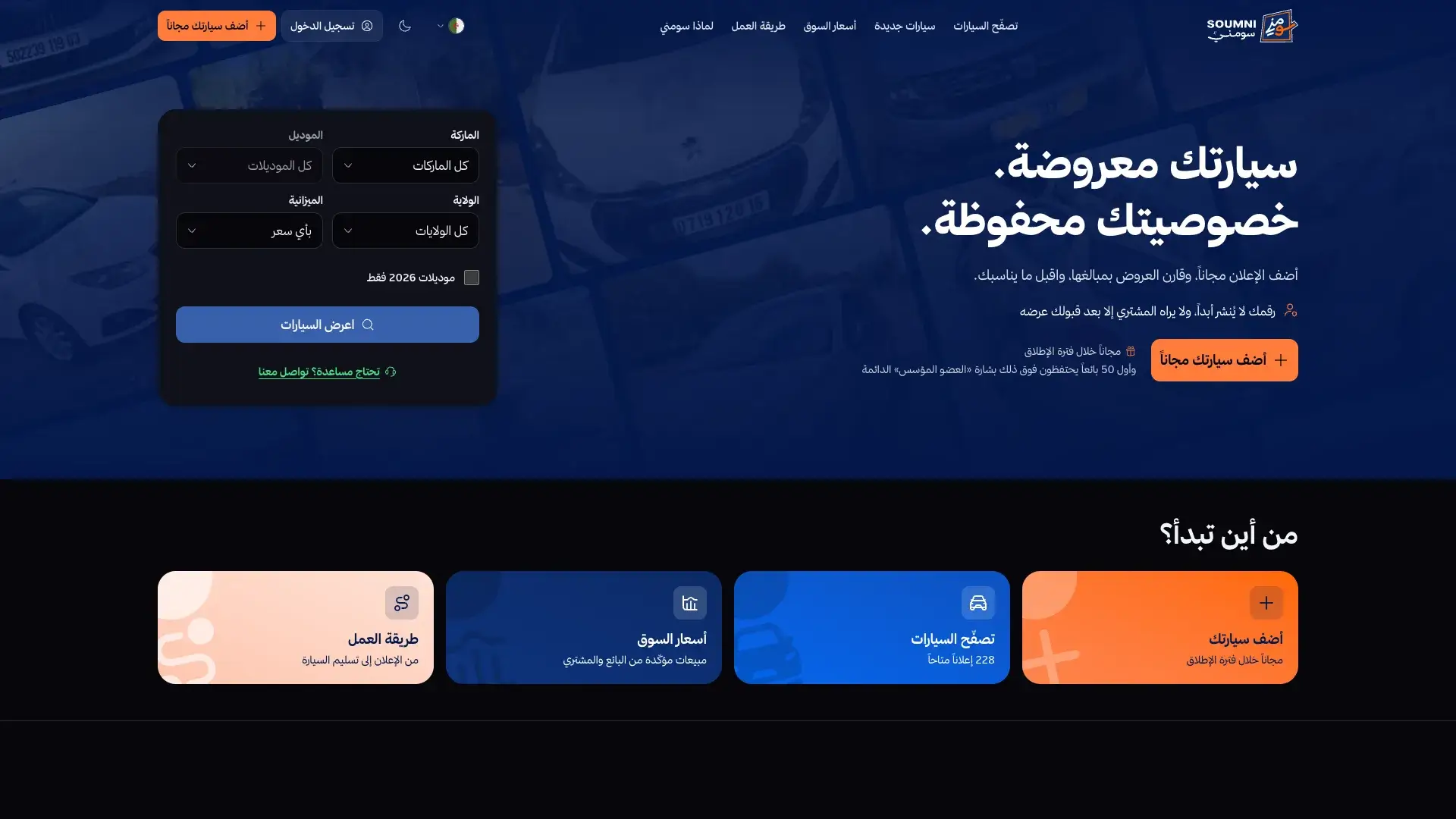
The same page in Arabic. The interface was designed right to left first, with French and English alongside.