Which option is right for your business?
There is no single best option, only the best fit for your situation. DIY builders trade capability for low cost. Freelancers give you senior, hands-on work at a middle price. Agencies give you a full team and process at the highest cost. The table below lays the trade-offs side by side.
| Factor | DIY builder | Freelancer | Agency |
|---|---|---|---|
| Typical cost | $150 to $600 a year in subscriptions | Roughly $1,500 to $8,000 for a small business site | $10,000 to $75,000 and up |
| Who does the work | You | One senior person, end to end | A team: project manager, designers, developers |
| Design and code quality | Bound by templates | Fully custom, depends on the individual | Fully custom, depends on who is assigned |
| Speed to launch | Fast, if you have the time | Fast, with direct communication | Slower, more coordination and sign-offs |
| Ongoing support | You handle it | Same person who built it, on a retainer | Account manager and support tiers |
| Biggest risk | You outgrow the template | The individual gets busy or moves on | Cost, layers, and junior execution on your account |
| Best for | Simple brochure sites, tight budgets | Most small to mid-size business sites | Large brands, big multi-team projects |
Bottom line: pick DIY when the site is simple and money matters more than time, a freelancer when you want custom work without overhead, and an agency when the project is too big for one person to carry safely.
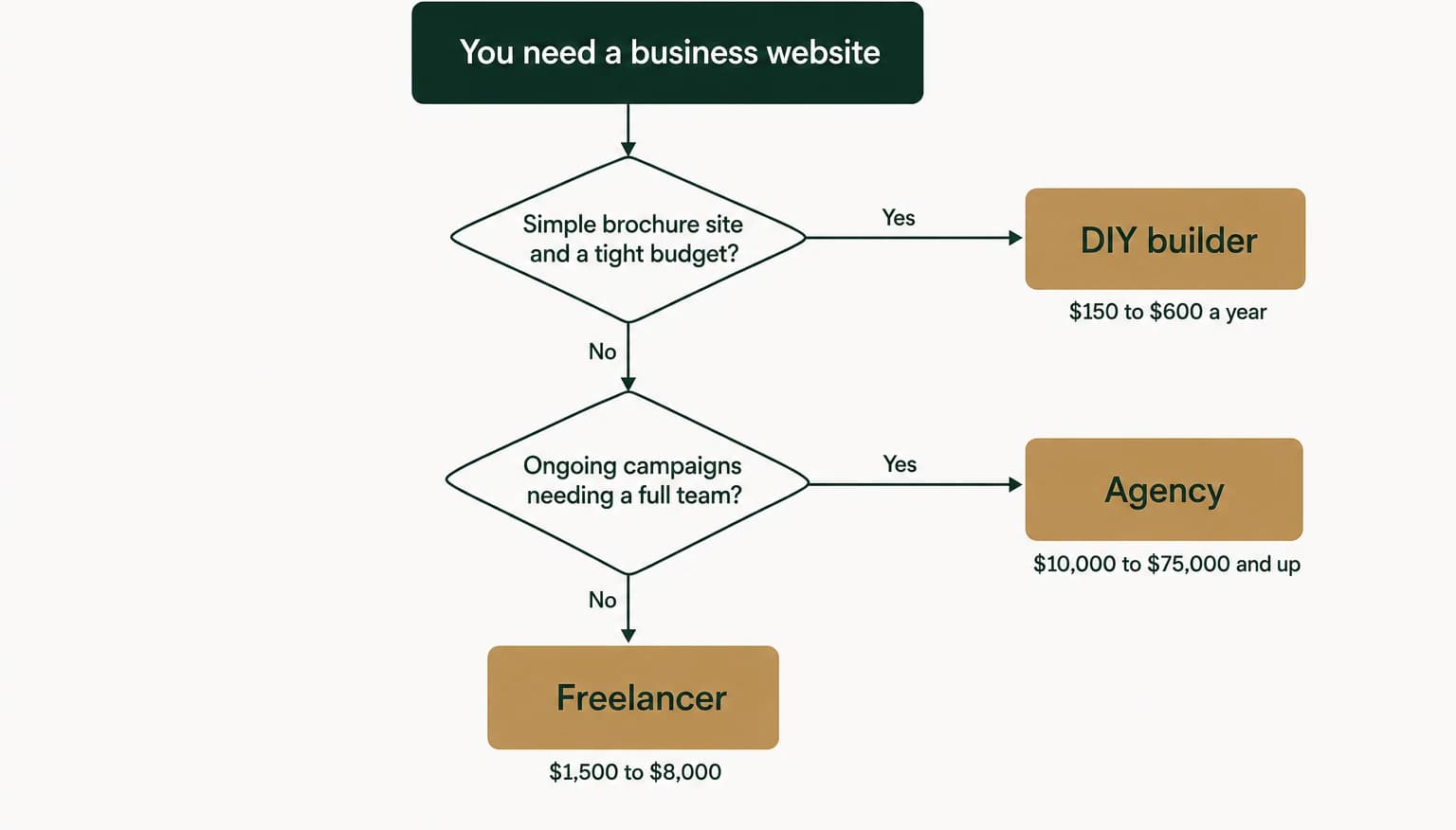
When is a DIY website builder the right call?
A DIY builder is the right call when your site is simple, your budget is tight, and you have time to build it. For a basic brochure site, a single landing page, or an early idea you want to test cheaply, tools like Squarespace, Framer, Webflow, or WordPress with a theme will get you live for the price of a subscription.
The honest catch is that DIY trades your time and a ceiling on quality for that low price. Templates look like templates, and the moment you need something the builder was not designed for, a custom booking flow, real performance work, a specific integration, you hit a wall. My rule of thumb: if the website is a nice-to-have, start with DIY. If the website is how customers find you, judge you, and buy from you, it is worth paying a person.
When should you hire a freelancer?
Hire a freelancer when you want custom, senior-level work without agency overhead. You work directly with the person building your site, decisions are fast, and you are not paying for account managers or office space. For most small and mid-size business sites, this is the sweet spot on price and quality.
The trade-off is redundancy. A freelancer is one person, so there is no bench if they get busy or step away. You lower that risk by hiring someone with a long track record, clear communication, a maintenance agreement, and code you own outright. Ask to see shipped work, not just mockups, and confirm the repository and accounts will be in your name.
When not to hire a freelancer
I would rather say this plainly than win the wrong project. Do not hire a single freelancer when your work genuinely needs a team: several parallel workstreams, deadlines that truly cannot slip, strict compliance and uptime guarantees, or a large ongoing campaign across many channels. In those cases an agency's redundancy and capacity are worth the higher cost, and a good freelancer will tell you so.
When does an agency make sense?
An agency makes sense when the project is bigger than one person can safely carry. You are paying for capacity and process: a team that can run parallel workstreams, cover for each other, and bring specialists for brand, motion, or paid media. For large organizations and complex, multi-quarter builds, that structure earns its cost.
The trade-offs are cost and distance. You pay for the overhead that makes the team possible, and the senior people who won the pitch are not always the ones writing your code. Communication runs through account managers rather than the maker. None of that is a reason to avoid agencies, it is a reason to make sure the size of your project actually justifies the structure.
How I think about it after 9+ years and 300+ projects
I have shipped more than 300 projects over 9+ years, for clients ranging from PepsiCo and Ooredoo to the European Union, and I have worked as the solo builder and inside agency teams. That mix is why I do not think one model wins. Most business sites I take on are the classic freelancer case: the owner wants custom work, a direct line to the person building it, and no overhead. I have rebuilt an architecture studio's site off WordPress and moved 131 pages without losing its search ranking, I regularly take over stalled or abandoned builds, and I still maintain sites I first shipped over four years ago. That continuity is the quiet advantage of working with one accountable person.
But I have also watched projects that truly needed a team get squeezed onto one freelancer, and it helps no one. If your build is large, deadline-critical, and spread across many workstreams, hire the agency. If it is a focused, custom site where quality and a direct relationship matter most, hire a freelancer. If it is simple and you are watching every dollar, start with DIY and upgrade when the site starts carrying real weight.